
Sometimes cancers are easy to diagnose. They start as a lump, a lesion, or a nodule that physicians can readily identify.
Then there are cases like Garry Keller’s, where a constellation of seemingly unrelated symptoms — a swollen lymph node, a blood clot, a suspected hemorrhoid — led to a battery of tests and finally a diagnosis: mucosal melanoma. Unlike the skin cancer melanoma, mucosal melanoma develops on the thin, moist lining of some organs and other parts of the body, such as the nasal passages, mouth, esophagus, urinary tract, rectum, and anal canal.
“Nobody was making the connection from the blood clot to the hemorrhoid, and I was like, ‘Well, I guess I could have a hemorrhoid? Maybe that's what we're dealing with,’” remembers Keller, who lives in Fort Collins, Colorado. “And then, after a PET scan, they said, ‘Oh my gosh, that thing's lighting up.’ They determined that the hemorrhoid wasn't a hemorrhoid; it was a tumor.”
Signs but no symptoms
That was back in 2016, when Keller was 40 years old and feeling fine. He was working out every day at a CrossFit gym, with no symptoms from the cancer that was starting to spread throughout his body.
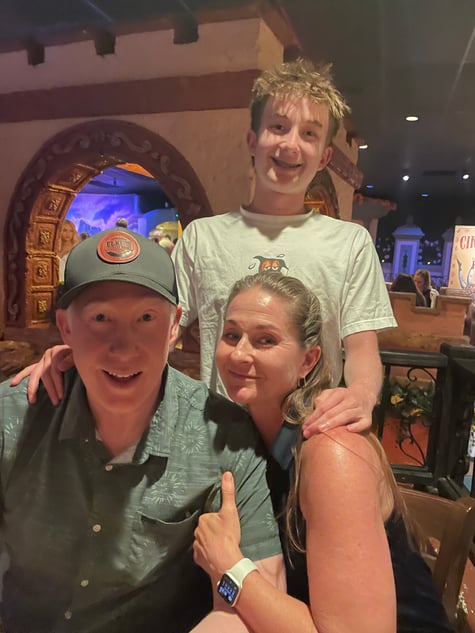 Garry Keller with his son, Boden, and wife, Becky, at Casa Bonita.
“That was a hard part of the whole process, where I didn't feel sick, and all these doctors are telling me I'm really sick,” he says. “There was a big part of me that felt like, ‘If I hadn't ever talked to these people, then I wouldn't even know, and I'd still be living my life.’ And now I'm looking at starting treatment that I know is going to make me feel lousy.”
Keller’s oncologist in Fort Collins recommended surgery to remove the cancerous lymph nodes, followed by a course of immunotherapy, but Keller wanted a second opinion. His father-in-law had been treated for melanoma at the University of Colorado Anschutz Cancer Center a couple of years before Keller’s diagnosis — ultimately dying from the disease — and coincidentally, one of Keller’s friends was diagnosed with mucosal melanoma around the same time that Keller was.
“We were having conversations about it, and he said, ‘You’ve got to get down to Anschutz.’" Keller recalled. “So I called down there, they got me an appointment — it was pretty quick. They got me in, and I canceled the surgery for the lymph node resection and started working with Dr. Medina.”
Starting on a clinical trial
Theresa Medina, MD, associate professor of medical oncology in the CU Anschutz School of Medicine, is also a faculty member in the CU Anschutz Center for Rare Melanomas.
Because Keller’s disease was advanced and beginning to spread, she opted for a systemic treatment that would attack the disease everywhere at the same time. It was the early days of using immunotherapy to treat mucosal melanoma, and she started Keller on a clinical trial examining the efficacy of combining two immunotherapy drugs, epacadostat and nivolumab.
“We were just starting to use these immunotherapies, so there was a lot of interest in optimizing the treatments we had at the time,” Medina says. “Even today, there are still a lot of trials available for people who have never had treatment before.”
The combination slowed the progression of Keller’s cancer for nearly two years, then it stopped working. Medina put him on a second clinical trial that had little effect, and Keller started getting worse, with multiple tumors that metastasized to his skin.
“My wife told me that she couldn't give me a hug without feeling a tumor,” Keller says. “You could see the lumps on my body.”
Giving TIL a try
That’s when Medina suggested a clinical trial of a personalized immunotherapy called tumor-infiltrating lymphocytes, or TIL, in which white blood cells — or lymphocytes — that are already fighting a tumor are removed from the body, multiplied and re-engineered in the lab, then reinfused into the patient. Keller was the first patient at CU Anschutz to be enrolled.
“The thinking behind it is that those lymphocytes in the tumor have receptors that are already capable of recognizing differences between normal cells and melanoma cells,” Medina says. “The antigens on the melanoma cells are activating these T cell receptors, but they're shut down by the cancer, so they're no longer actively fighting the cancer cells. If you surgically remove the tumor, you can isolate the lymphocytes within the tumor, expand them, and then by adding a couple of cytokines, you can switch those T cells into cytotoxic, or killer, T cells, so they're reactivated to go after the melanoma cells.”
For Keller, the third time was the charm. Within weeks, his tumors began to shrink. One way Medina could tell the treatment was working was that Keller developed vitiligo — a loss of pigment in the skin and hair — that turned out to be permanent. None of his moles are visible, and his hair, eyelashes, and eyebrows have all turned a stark white.
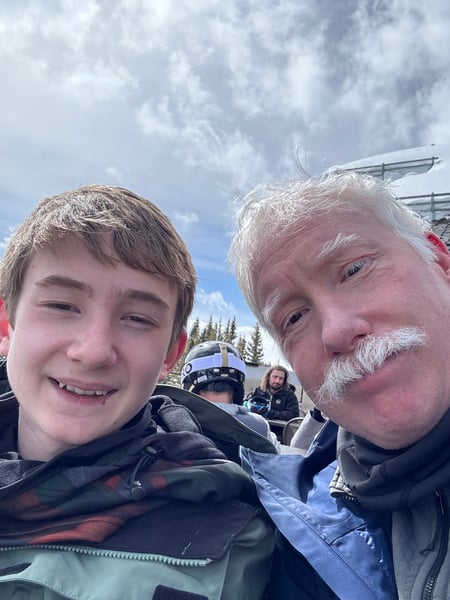 Garry Keller on a snowboarding trip with his son, Boden, showing off his newly white mustache and eyebrows.
“We think of it as a good prognostic sign if you get vitiligo because of the shared antigen with the melanoma cells,” Medina says. “Garry came in four weeks after the TIL treatment, and the lymph nodes already felt a little bit smaller. Then he had a scan two weeks later that confirmed that his disease was significantly improved.”
Keller continued to get better in the weeks and months that followed, slowly transitioning from seeing Medina every three weeks to every three months, then every six months.
“Last time I was there, she said maybe it should just be once a year,” Keller says. “Dr. Medina is a superhero. I can't speak highly enough of her. She would say, ‘I want to try this,’ and in my mind, it was like, ‘I’ve got to listen to Dr. Medina. She tells me to go through this wall — we're going through it.”
Immunotherapy to the rescue
Keller received his TIL treatment in 2018; the procedure was approved by the FDA in 2024 thanks to clinical trials including the one in which he took part. Today he shows no evidence of disease, and he says he has a deeper appreciation for spending time with his wife and his son, who is now 16, and for doing the outdoor activities he loves, including rafting and snowboarding.
He’s also glad he pushed for a second opinion and ended up under Medina’s care — he recommends that anyone diagnosed with cancer look into immunotherapy and seek care at centers like the CU Anschutz Cancer Center, which is the only authorized treatment center in Colorado for TIL in melanoma patients.
“I would absolutely recommend seeking out somebody who works with immunotherapy,” he says. “Immunotherapies are amazing and very powerful, and they're just at the tip of the iceberg of understanding how they work and how to harness the immune system to fight the cancer. I'm pretty sure, if I would have been a couple months off from being able to join that trial, I wouldn't have made it.”
Featured image: Garry Keller with his son, Boden.