Today’s teenagers will undoubtedly see major advances in cancer care across their lifetimes, given the rapid pace of research breakthroughs. Some of the teens gathering this summer at the University of Colorado Anschutz could grow up to create breakthroughs themselves.
These area middle- and high-school students are learning about cancer research, rubbing elbows with experts, tackling cancer-biology problems in exercises, and getting hands-on experience in labs.
They’re enrolled in a new program of the CU Anschutz Cancer Center called START, for Students and Teachers Achieving Cancer Research Experiences Together.
The summer camp initiative, in its first year, is aimed at inspiring students entering seventh through 10th grades at nearby schools to pursue biomedical research in college and as a career, while also increasing the local community’s understanding of cancer research and prevention.
“The START program will transform our community by cultivating and strengthening research skills and inspiring historically underrepresented students to envision cancer research as a profession,” says a grant proposal submitted to the National Cancer Institute (NCI) by cancer center associate director of Cancer Research Training and Education Coordination (CRTEC) Eduardo Davila, PhD, and cancer center member Meredith Tennis, PhD, along with Aimee Bernard, PhD, associate professor of immunology and microbiology and a leader of community science-education initiatives.
The NCI has provided $370,000 in first-year funding for START under a five-year grant. START operates under the cancer center’s CRTEC office, which supports a number of multidisciplinary education and training programs aimed at fostering the next generation of scientists. CRTEC is led by Davila and Adela Cota-Gomez, PhD, the cancer center’s assistant director for education administration.
“One of the CRTEC office’s most profound goals is to motivate young people to envision themselves as future cancer researchers,” Cota-Gomez says. “We are incredibly excited to offer summer camps focused on cancer research to our community’s youth.”
In START’s inaugural year, 159 applications were submitted for incoming seventh and eighth graders, and 134 for ninth and tenth graders, according to program coordinator Molly Naylor, MA-TESL. Of those, 76 were accepted at random for START.
The camp’s main objectives are to expose students to what cancer researchers do, introduce them to basic lab techniques and how to document results, and cover how to communicate to researchers and the public. Plus, students learn that mistakes are a part of learning.
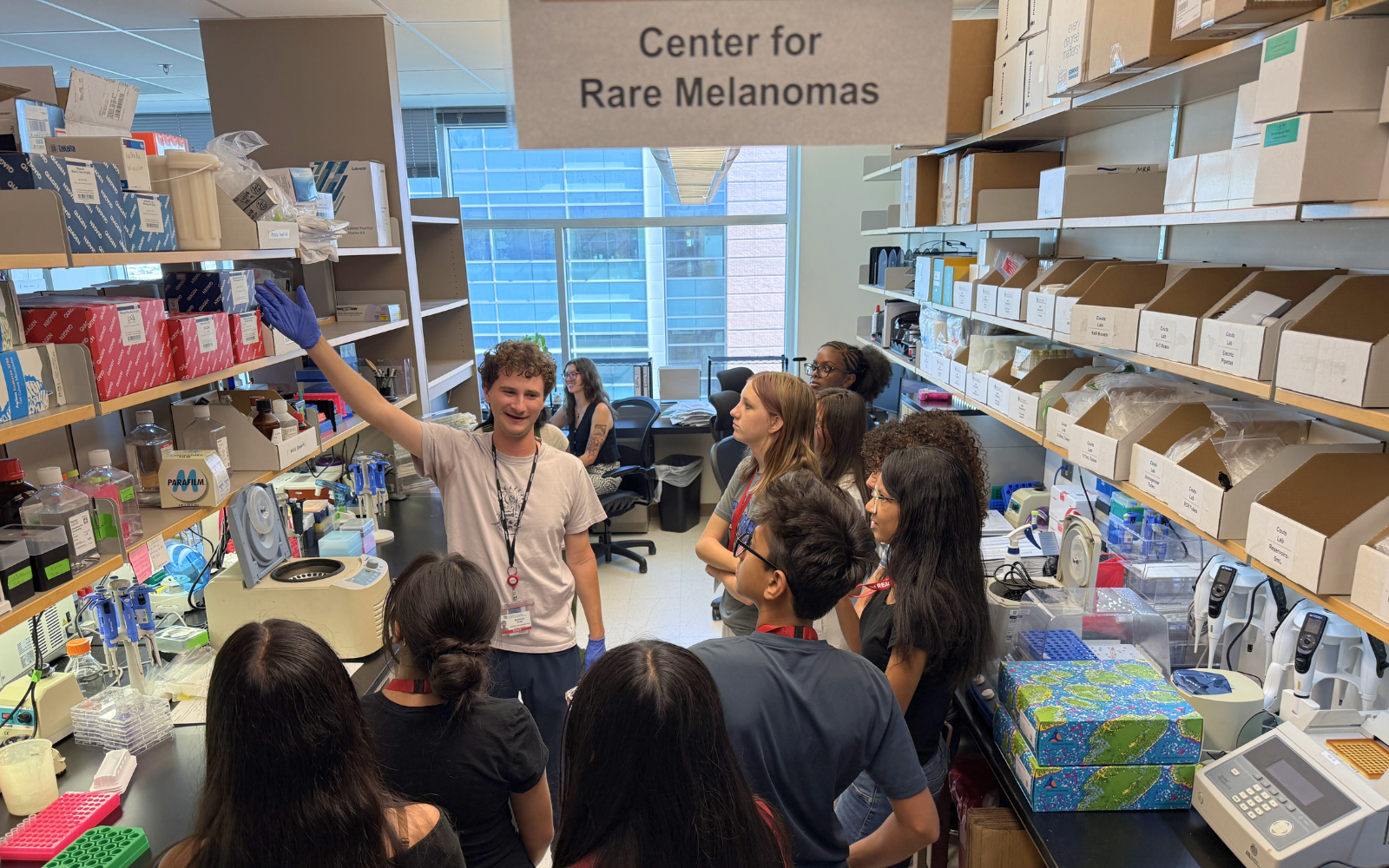
Photo at top: Lab manager Nicolas Ryan leads START campers on a tour of the lab of Kasey Couts, PhD. All photos by Mark Harden | CU Anschutz Cancer Center.
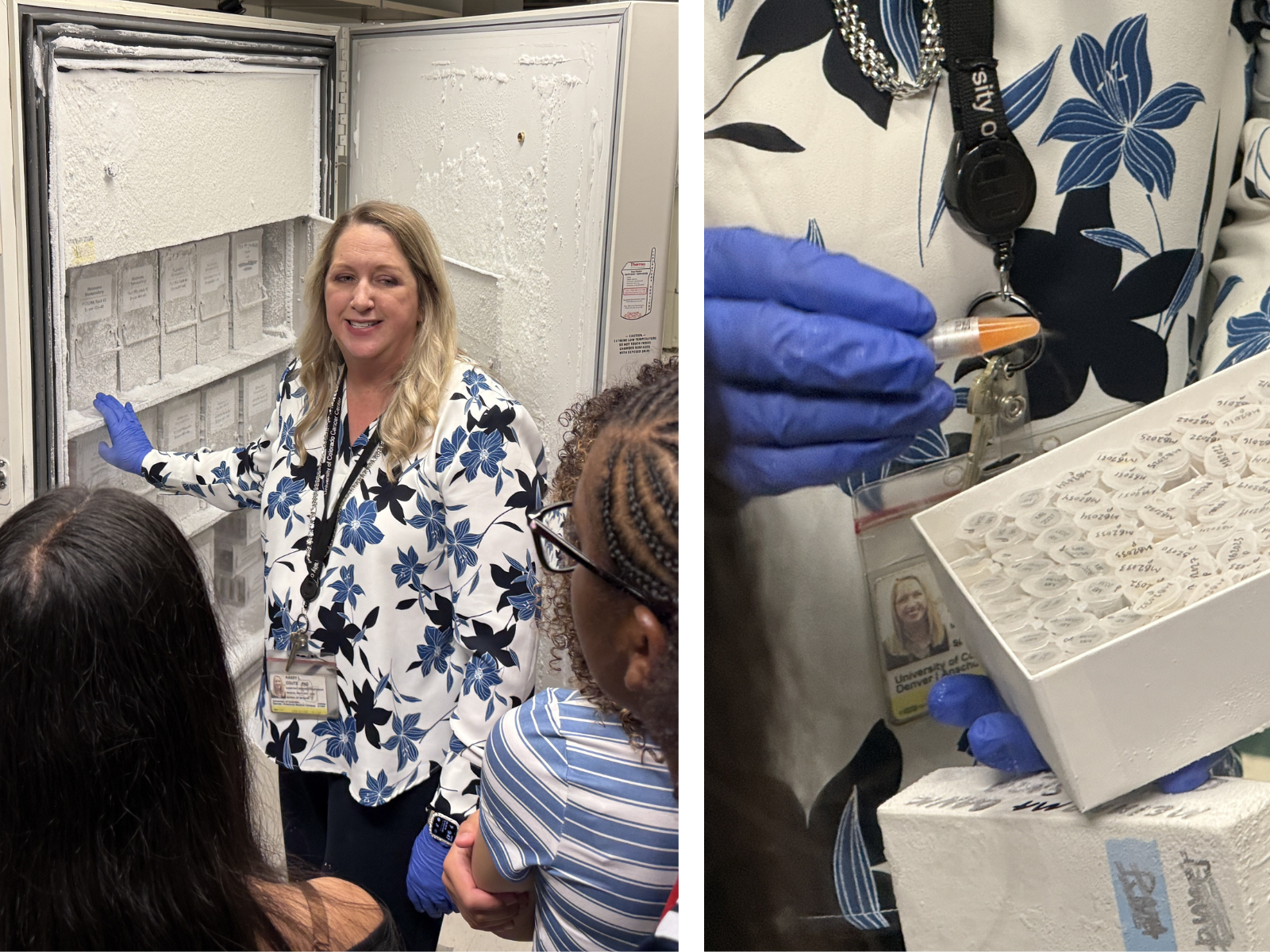
Kasey Couts, PhD, shows campers a biobank of cryopreserved tumor samples.
‘Think about what you want to do’
During a recent Friday classroom session for ninth graders, skin cancer was the topic. Campers heard from cancer center member Kasey Couts, PhD, associate professor of medical oncology and co-director of the CU Anschutz Center for Rare Melanomas. She walked the students through the basics of melanoma and how research has driven new treatments.
Couts explained that her own path to research began in high school with summer math and science camps, and that she later became passionate about working to find better therapies for rare, non-sun-related melanomas.
“It’s great that you guys are here, and I encourage you to take advantage of as many of these kinds of experiences as you can as you think about what you want to do for your career,” she told the students.
Couts also talked about cryopreservation of tumor tissue in extreme cold to maintain live cells for experiments and analysis. The students then visited a biobank where thousands of tissue samples collected with patients’ consent are stored in freezers for research. In nearby labs, they looked at tumor cells under a microscope and learned about polymerase chain reaction tests to identify cancer-causing genetic changes.
Back in the classroom, Laura Brilla – a science teacher from Aurora’s Vista PEAK Preparatory high school, one of the START facilitators – led the students through a tabletop activity on skin cancer. They were provided with a photo of a mole on the shoulder of a patient named “Sofia” and a skin cancer fact sheet, and were asked whether the mole should be further examined, what type of cancer Sofia might have, and provide evidence to support the answer.
Other sessions across the two-week camp include cancer types and trends, lab safety, writing research questions, science myths and misinformation, a visit to Children’s Hospital of Colorado, and much more.
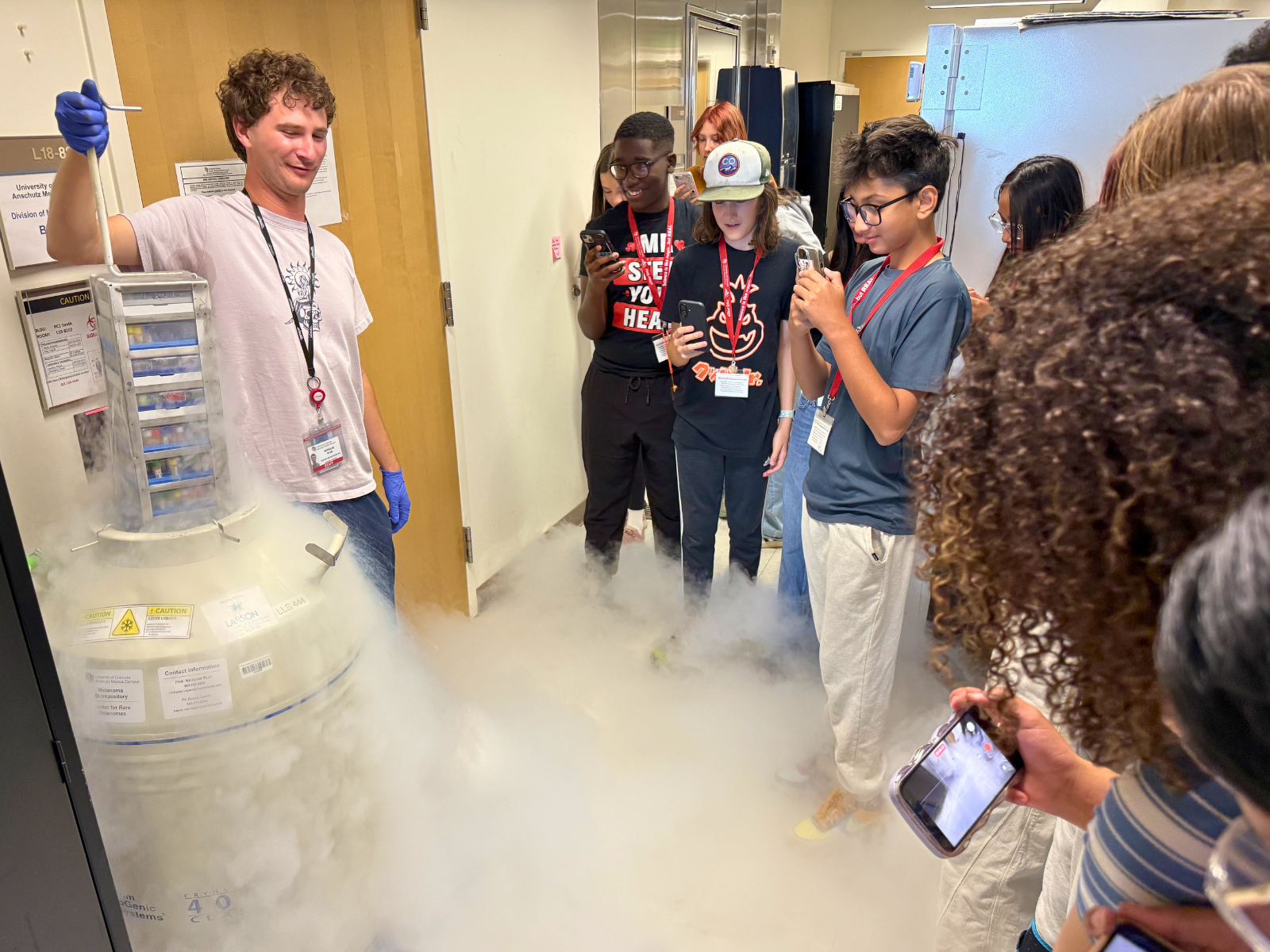
Nicolas Ryan impresses START campers by extracting samples from a liquid nitrogen-cooled container.
‘Science might be my path’
Two rising seventh graders participating in START said they learned about the program from their parents, and that the camp appealed to their interest in science.
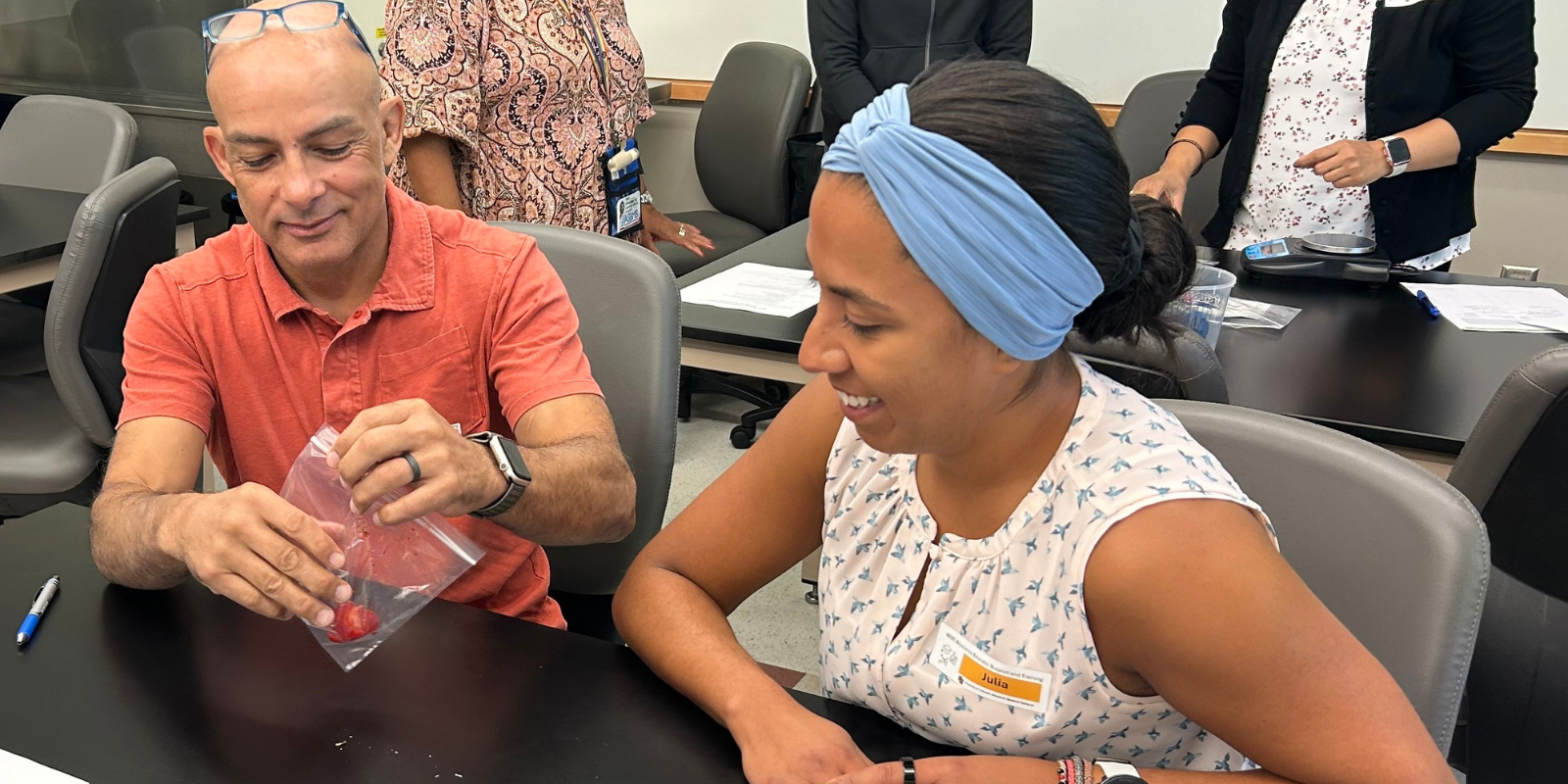
Riley Sanders, 13, a student at Girls Athletic Leadership Middle School in Denver, said she isn’t sure yet what career she will pursue, “but I do think that something in science might be my path.” Riley said she enjoyed all the lab exercises so far, especially one where students extracted DNA from a strawberry. “I like learning about new things and then doing physical activities, like labs,” she said.
Jaival Maharaja, 14, a student at American Academy Lincoln Meadows in Parker, said, “I’m not sure what path I should be on when I’m older, but I’m thinking about medicine, so I think this is a great opportunity to know what it’s like and see if I have any interest.”
Feedback on the program from parents has been positive so far, START leaders say. They hope to continue the initiative after the five-year NCI grant expires.
“We hope that the experience will nurture their innate curiosity and inspire them to pursue the path of cancer science,” Cota-Gomez says. “Who knows, but maybe the seed for the next cancer breakthrough has already been planted in one of their minds.”
Parallel initiatives under the START program include a seven-week summer research experience for students entering 11th grade, and a research experience for high school science teachers that includes a two-month summer program.
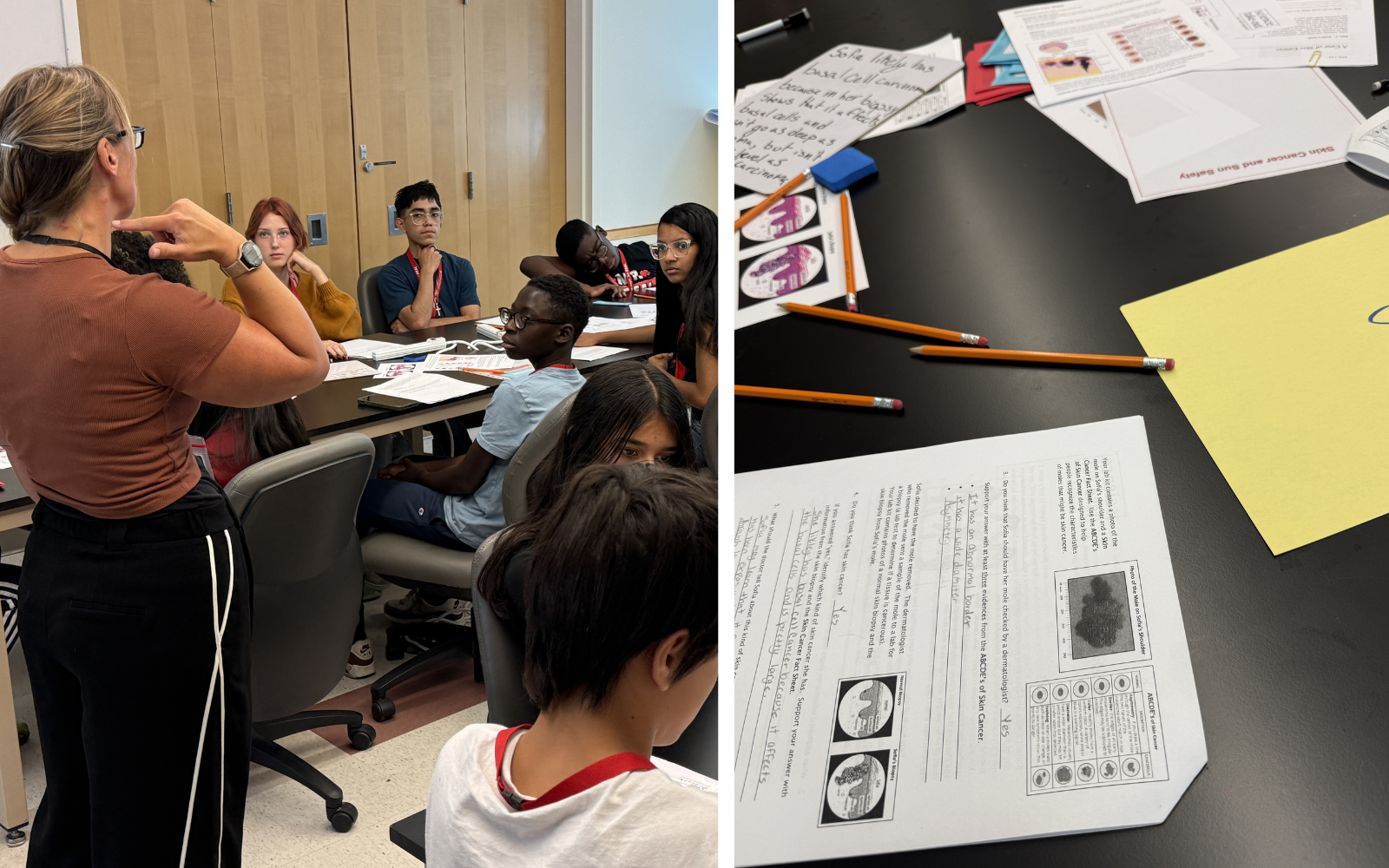
Facilitator Laura Brilla leads campers on a skin cancer tabletop exercise.