

With Artificial Intelligence (AI) rapidly expanding, it seems as if there is a constant flow of news reports, advertisements and social media posts promoting the development of a new tool that promises to accelerate or automate some aspect of our lives. The same is true in healthcare and the sciences, where AI technologies are changing the way that researchers and clinicians think about the future of biomedical research.
In 2023, the world was taken by storm as an influx of chatbots powered by Large Language Models (LLMs) surged into the public domain. Since then, the technology behind these LLMs has continued to expand and improve. Recently, there has been an increase in talk about AI tools that can automate complex, multi-step tasks. These systems are known as AI Agents, or Agentic AI.
The Takeaway:
AI Agents are complex software tools that leverage a core AI system to delegate tasks to tools and other sub-systems in order execute complex, multi-step workflows.
Recently, Agentic AI has gained significant attention in the sciences, with a variety of tools being developed and published to support different research tasks and workflows.
- These systems demonstrate considerable potential for research, but scientists are still wondering what the integration of these tools will look like for science.
AI Agents and Their Role in the Sciences
AI Agents (Agents) are computational systems that can autonomously execute workflows using a variety of tools and resources. New implementations of these tools, at their core, often leverage similar LLM technology as AI chatbots. However, unlike a chatbot, these Agents are built to delegate and coordinate with other technology tools to plan, execute and supervise complex tasks.
Like other forms of AI, these Agents have made their way into the sciences, as well. Researchers across the world are developing Agents to support various components of the scientific process, such as an AI system that seeks to reduce the burden of scientific software development, or the Co-Scientist tool that aims to help with hypothesis generation. In fact, a recent publication in Nature introduced a tool called Robin that can review literature, develop hypotheses, suggest experiments and analyze data—enabling a computer to conduct what the authors called “a semi-autonomous approach to scientific discovery.”
Yet, as with other AI developments, many researchers are wary of outsourcing too many tasks to these systems in fear that we may lose something important along the way.
To better understand the foundations of Agents and the role of these Agents in biomedical research, we spoke with researchers at the Department of Biomedical Informatics (DBMI) at the University of Colorado Anschutz (CU Anschutz) who are working with Agents as part of their research process.
What Is an AI Agent?
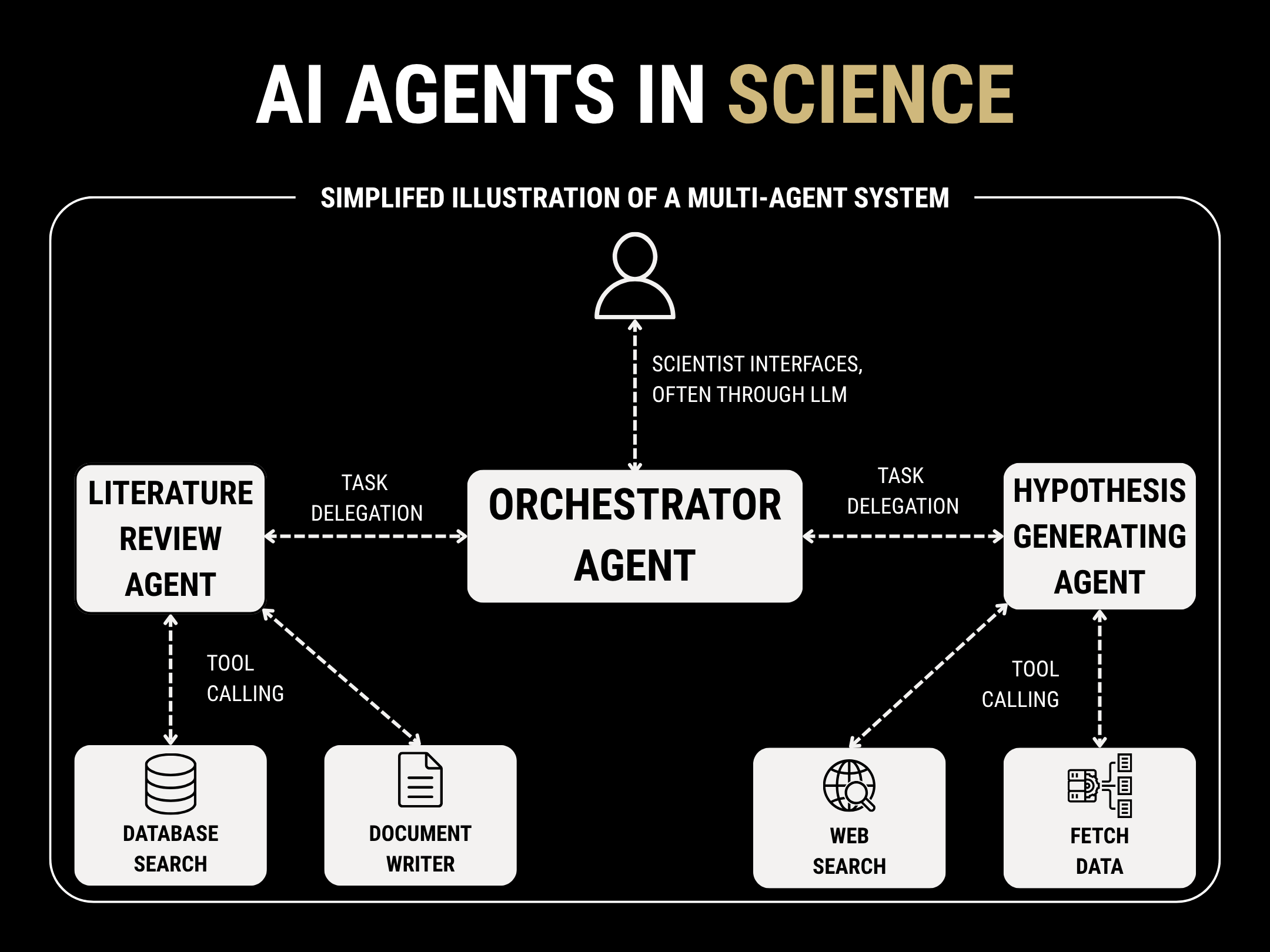
An AI Agent is a system of tools with unique, isolated responsibilities. Agents have the ability to delegate responsibilities and leverage additional tools (or even additional agents), to support their work.
Understanding the Difference Between Chatbots and AI Agents
When LLMs were first popularized in the public domain in late 2022 and early 2023, most public-facing applications were primarily LLM-powered chatbots with a single conversational model. These chatbots would leverage a core LLM to interpret user prompts, generate responses and maintain conversational context throughout an interaction.
Yet, in the past few years, engineers and developers have built systems that allow these LLMs to go beyond the chatbot interface, and also leverage tools to accomplish additional tasks that are not part of their inherent knowledge base. This evolution has given rise to complex AI Agents, which combine LLM reasoning with external tools (for example, writing a file on a computer, executing Python code, or downloading a webpage) as well as other abilities to execute complex, multi-step workflows.
"A chatbot is just an interface to a system. The system could be a single agent—a single LLM—or a multi-agent system," said Milton Pividori, PhD, assistant professor of biomedical informatics at CU Anschutz. Pividori and his team in the Pividori Lab have started to leverage AI Agents in their biomedical research.
"The architecture of a multi-agent system usually has an orchestrator agent—something that coordinates tasks. This orchestrator can have access to an agent that does a literature review, another agent that specializes in generating hypotheses, another agent that looks at hypotheses and ranks them, another agent that can take some ideas/hypotheses, and maybe run some experiments in Python,” explained Pividori.
“That task isolation is important, because these Agents are based on LLMs, and LLMs have a limited context. We know that the larger a context gets in a system, the model gets confused, and it hallucinates more. So, it's better to keep functions and responsibilities isolated. That's why the multi-agent aspect is useful. So, the chatbot is just an interface, but behind that there could be a simple single-agent system, or a multi-agent system," said Pividori.
Haoyu Zhang, software engineer in the Pividori Lab who is supporting the implementation of AI Agents in their research, further expanded upon the multi-agent architecture with an analogy:
"Suppose we're building a video game. The orchestrator agent is the game director, and the director works with a whole set of specialists: a sound designer, a graphics programmer, a narrative writer," explained Zhang.
"You can certainly ask the director how to design a particular sound effect, and you'll get an answer. But will it be the most accurate or the most in-depth one? Probably not. The better path is to ask the director, and have the director go to the sound designer, because that's the person actually doing the work."
Zhang extended the analogy, offering further insight into how it applies to AI Agents: "So as a user, you don't need to know who does what. You just say: ‘add a sound effect for opening a treasure chest.’ Internally, the director recognizes this as an audio problem and hands it to the sound designer, who asks the things you didn't think to ask: ‘Is the chest wooden or iron? Is this a reward, or a trap?’ Neither of those is the sound designer's call. The material belongs to the concept artist, the reward-or-trap question to the narrative writer. So the director routes those too, then comes back with one finished sound effect—not three opinions you have to reconcile yourself,” said Zhang.
Tools in AI Agents
One of the characteristics that makes AI Agents unique is their ability to leverage tools beyond LLMs, which is referred to as ‘tool calling.’ For example, an agent could call a tool that searches the web; a tool that writes and executes Python code; a tool that interprets an image file; or a tool that searches a database like PubMed or OpenAlex.
This tool functionality allows the Agents to go beyond their knowledge base to find information. It also allows Agents to interpret and create documents (like images, for example) that are not just text.
Misconceptions About AI Agents
AI Agents are surging in popularity. In fact, according to Google Trends (at the time of writing), public interest in AI Agents has risen immensely in the past year, increasing more than 550% from the previous year.
Although their popularity is now growing, and modern implementations of these agents are often based on modern LLM models, Agents have been around for some time.
Yanjun Gao, PhD, assistant professor of biomedical informatics and co-director of the Center for Health AI (CHAI) at CU Anschutz, illuminated the story:
“A misconception that I’m seeing is that people think that AI Agents have only come out recently, but this is not so,” said Gao. “Actually, AI agents have been developed since almost two decades ago.”
“At this time, there were models that used probabilistic language models that would take customer’s phone calls and help them book airplane tickets or train tickets, for example,” explained Gao.
The technique they were using at the time was called ‘slot filling,’ which is a form of Natural Language Processing (NLP), but a different technology than what is behind today’s LLMs. Instead, slot filling would extract specific pieces of information from text to fill ‘slots,’ like a date or a time.
“Those agents would have a template, and they would follow that template to capture a customer’s call. So let’s say a customer calls an airline company, and they say ‘I want to book an airline flight from Denver to LA on Friday, August 14 at 2:00 p.m.’ The backend of that agent is using this slot-filling technology to capture—here’s the date, here’s the destination, here’s the departing city, here’s the time. Then, they can search their database to see if there is a slot to meet the criteria.”
Although these models have come a long way, it’s important to note that AI Agents are not a net new fixture in the AI community.
How AI Agents Are Being Used in Science
Agentic AI is being implemented in various ways across a breadth of scientific disciplines.
As one example, the Pividori Lab recently received a grant to support research on Type 1 diabetes (T1D). Specifically, the researchers are looking at how molecular patterns in blood can be used as a biomarker to better understand T1D. These molecular patterns are modeled as ‘gene modules’: a group or list of genes that represent complex, context-specific gene-gene interactions that carry out biological functions.
"I'm interested in the human-AI interaction. Sometimes it feels like the AI is the main actor, and the human is just there to check a few things. But I believe more in an approach where the human provides the key insight, and the AI augments the human with the more mechanical stuff—using the particular angle of looking at things from the human researcher."
— Milton Pividori, PhD
Zhang expanded on how their lab is implementing Agents: “basically, we want to use multiple Agents to integrate our current tools and knowledge base to generate some hypotheses related to T1D,” said Zhang. “We have a gene list, and given that gene list and our integrated knowledge and tools, we want to understand: do these genes have something to do with T1D? How do they interact with each other? What are their roles? Do those genes belong to the same gene modules, or not?”
Pividori explained that they hope these AI Agents will support the development of new hypotheses in their lab. "We want to use these multi-agent systems to generate hypotheses, of whether a module—given all of the multi-dimensional information—makes sense or not. Without AI Agents, we basically search in Google for these patterns. So, you could have one agent that searches PubMed or OpenAlex, you could have another agent that pulls from a database. It's doing both a lot of manual, time-consuming, mechanical stuff, plus biological reasoning on top of it that a human researcher can review."
As another example, Gao and her team in the LARK Lab leverage AI Agents to support cross-disciplinary work. Gao explained that many of her lab members have a computer science background, but the AI Agents may be helpful to them when working with biological data that might be outside of their domain knowledge.
“Of course, these have to be safe and HIPAA compliant if the dataset has anything about patients,” emphasized Gao. “These Agents have to be following regulatory compliance, first. That is the premise of doing anything [with them].”
AI Agents and Human Scientists
As more sophisticated and capable AI Agents make their way into science, scientists are interested in how their workflows and roles will change as a result of this transition.
Pividori sees these types of tools as very valuable as supplementary supports for human researchers, but not in place of human researchers. "They can be very valuable when a human researcher has a particular way of looking at things, and the systems integrate into this way of looking at things—not the other way around," said Pividori.
"I'm interested in the human-AI interaction," said Pividori, "sometimes it feels like the AI is the main actor, and the human is just there to check a few things. But I believe more in an approach where the human provides the key insight, and the AI augments the human with the more mechanical stuff—using the particular angle of looking at things from the human researcher."
Gao explained that these AI Agents are beginning to be able to achieve “end-to-end science,” meaning they can automate the scientific workflow, including hypothesis generation, research, data collection, data analysis, and writing based on a prompt. “I do think these will be more and more frequent and will be a part of our research workflow, regardless of whether we like it or not,” said Gao.
Yet Gao also believes there is still a human essence that AI will never be able to replicate. "I don't think that AI is going to replace the human scientist," she said. "All of the people that become scientists—there is a strong personal reason. That personal reason could be an experience they have from their childhood, it could be that they have an experience of losing someone... I don't think AI will be able to replicate that feeling. AI can automate the research process, but it can never automate that true feeling behind our curiosity and passion towards science."
Considerations for Scientists Using AI Agents in Their Workflows
Although AI Agents are becoming integrated into science, there are important considerations scientists should make.
Gao emphasized that it’s very important that scientists and the tools they are working in compliance with their institutional policies and data regulations, especially in healthcare settings.
“A lot of times you probably don't need a fancy agentic system. A lot of times you probably just need to ask a couple of questions to a single LLM chatbot. I think people have the misconception that the newer the technology is, the better it is. But that’s not always the case."
— Yanjun Gao, PhD
Gao also pointed out that a common misconception is that people tend to think that AI Agents are superior due to their complexity. “It's not always the case that having AI Agents perform some task would be much better than a typical, single AI model,” she further explained. “Because a lot of times you probably don't need a fancy agentic system. A lot of times you probably just need to ask a couple of questions to a single LLM chatbot. I think people have the misconception that the newer the technology is, the better it is. But that’s not always the case.”



.png)