As the use of artificial intelligence grows rapidly in the modern world, it’s coming into greater use in medicine in a host of ways. And now, attention is turning to how AI-based tools might be employed in the fast-moving world of emergency medicine.
At various emergency departments across the country, AI tools are lending a hand with voice-to-text clinical documentation, workflow automation, rapid imaging analysis, and monitoring patient vitals, among other tasks. So far, AI tools are generally being used to support clinicians, but not as autonomous medical decision makers.
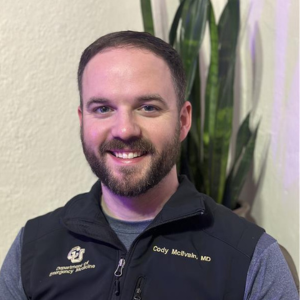
Two thought leaders on AI in the University of Colorado Anschutz Department of Emergency Medicine say it already supports their work, and they see potential for a greater role in the future. But Cody McIlvain, MD, and Arian Anderson, MD, MS– both assistant professors in the department and emergency-care clinicians – emphasize the need for further development and thorough testing before AI’s role can be expanded.
“Our general vibe about AI is excitement and enthusiasm for it, but with some very appropriately placed caution and patience about making sure it's rolled out effectively,” McIlvain says. “A lot of us use it for office or logistical tasks in our day-to-day work lives, and it's great for that, and I look forward to being able to use it more effectively in medicine. But we're going to go slow to make sure it's safe.”
“AI can automate huge amounts of tasks, but the human-to-human interaction, talking to someone about their health concerns, can never be replaced,” Anderson says. “So the question is, can we figure out a way to have more time at the bedside by automating all the other tiny tasks that we have to do?”
Supporting decisions
As AI’s role in emergency medicine grows, there’s a growing body of research examining the phenomenon.
For example, a study led by emergency medicine researchers at Yale School of Medicine, published last year in the journal NEJM AI, examined 174,648 emergency department visits across three sites. It found that implementing an AI-informed triage support tool was associated with improved identification of patients requiring critical care (from 78.8% to 83.1%) and reduced median time from arrival to the ED’s initial care area by 33%, from 12 to 8 minutes.
At CU Emergency Medicine, Daniel Lindberg, MD, leads an ongoing research project into using an AI tool to improve early recognition of child physical abuse in emergency and urgent care settings. It’s one of many AI-focused research initiatives underway at CU Anschutz.
Still, the body of peer-reviewed investigation into whether AI use improves patient outcomes is limited. And both Anderson and McIlvain say further work is crucial to answering questions about AI before its use in medicine can be expanded.
Today’s AI tools “are very accurate for the most part,” Anderson says, “but very accurate is not good enough to rely on when it comes to human health, especially in the emergency department.”
“I don't want it to send us down the wrong rabbit hole on a case if we defer too much to its response,” McIlvain says. “Ultimately, AI will be helpful as a ‘side by side’ aide – ‘Hey, did you consider this as a treatment or as a diagnosis?’ I think augmenting a physician in that way is going to be really helpful eventually. I just don't want it to replace natural thought.”
Anderson got interested in AI while doing spaceflight health research for NASA, where he worked on a project to develop an AI-powered clinical decision support system for astronauts with medical needs on deep-space missions. He is director of the dual-degree program in medicine and aerospace engineering with an emphasis in bioastronautics at CU Emergency Medicine and CU Boulder.
“A lot of AI challenges in medicine need both a data scientist who's well-versed in AI and somebody who understands the clinical context,” Anderson says. “Without both perspectives, clinicians want to do things that don't necessarily make sense or need AI, and data scientists will try to implement AI in places that aren’t as appropriate as they initially appear from the outside.”
→ CU Anschutz-Led Trial Finds AI System Improves Oxygen Delivery in Hospital Patients
Cognitive offloading
At the UCHealth University of Colorado Hospital ED where Anderson and McIlvain work, they use an ambient AI listening tool called Abridge that assists in drafting notes documenting patient information.
“It listens to a conversation with a patient and then will write you documentation for your note,” Anderson says. “You can set it to write expansively or the bare bones of what was talked about. If you verbalize your physical exam, saying, ‘I'm listening to the person's lungs and their lungs are clear,’ it will put that into the note.”
The ambient AI tool “allows for some cognitive offloading that is beneficial,” McIlvain says. “It allows us to focus more on patient care and to have to think less about notes in the back of my head that I haven't finished. Right now we’re studying to see if ambient AI reduces the time that you spend documenting and if it has an effect on efficiency. But at the very least, it helps us feel that it’s not a burden, that it’s one more thing on your to-do list during your shift that you have to get to. At least for me personally, that improves my general mood on shift. I feel slightly less stressed, and after my shift, I don't have as much weighing on me that I have to complete.”
“Especially in the emergency department, cognitive task load is one of the most important things we need to keep track of, so it’s great to know the note-taking app is running in the background,” Anderson says. “When we're seeing 20 to 30 complex patients a day, there have been times when I’m five patients later, and I suddenly think, ‘Oh, man, there was a specific piece of information that I needed on that patient I saw earlier. When did their chest pain start?’ And I'll go back to my ambient note, and it'll say, ‘Chest pain started yesterday.’ That’s great.
→ Arian Anderson, MD, on Health Risks Astronauts Face in Deep Space
More to come
McIlvain says that when AI health care applications began to roll out, “I thought that would happen a little faster than it has. But it’s appropriate that things have slowed down to ensure that they're safe and reasonable. And so the AI uses we're seeing in the ED right now are limited. Several of us are exploring different avenues where AI could be really helpful. We're all nervous about implementing something before we see proven safety profiles, but there are certainly more things coming down the road.”
At CU Anschutz, the Center for Health AI (CHAI) is an academic home for AI research leading to clinical impact. Researchers at the university are working to build large language models with the potential to support clinical decision-making while prioritizing safety, transparency and trust.
Asked what AI tools he’d like to see developed, McIlvain has a long list – many of which will take a while to arrive, he says. They include ways to more quickly identify patients needing high-level care and get them to the hospital department they need, new methods of moderating workload across provider and nursing teams throughout the hospital, and better ways to gather health-history information from patients during waiting periods so it’s ready when providers see them.
AI is “extremely good at finding patterns that we might not necessarily recognize,” Andersen says. “Clinicians may not jump to a super-rare diagnosis, the kind of thing you briefly learned about in med school that’s one in a million. But AI has the dataset to interpret patterns and point to a really esoteric diagnosis. So I think that could be where the future goes.”
Overall, McIlvain and Anderson see potential for AI to augment clinical experience and assist physicians in various ways. But they also emphasize the importance of understanding the limitations of AI and ensuring it does not replace critical thinking and clinical judgment.
For the foreseeable future, says Anderson, “AI tools that assist us in all of the tangential processes that we do are probably going to be more valuable than ones that try to do our clinical job. We’re extremely well trained at examining patients, asking questions, making diagnoses, and implementing treatments. AI will do a lot in getting patients flowing through the ED and figuring out what level of care they need in the hospital. That’s where AI will be a really helpful asset to us.”
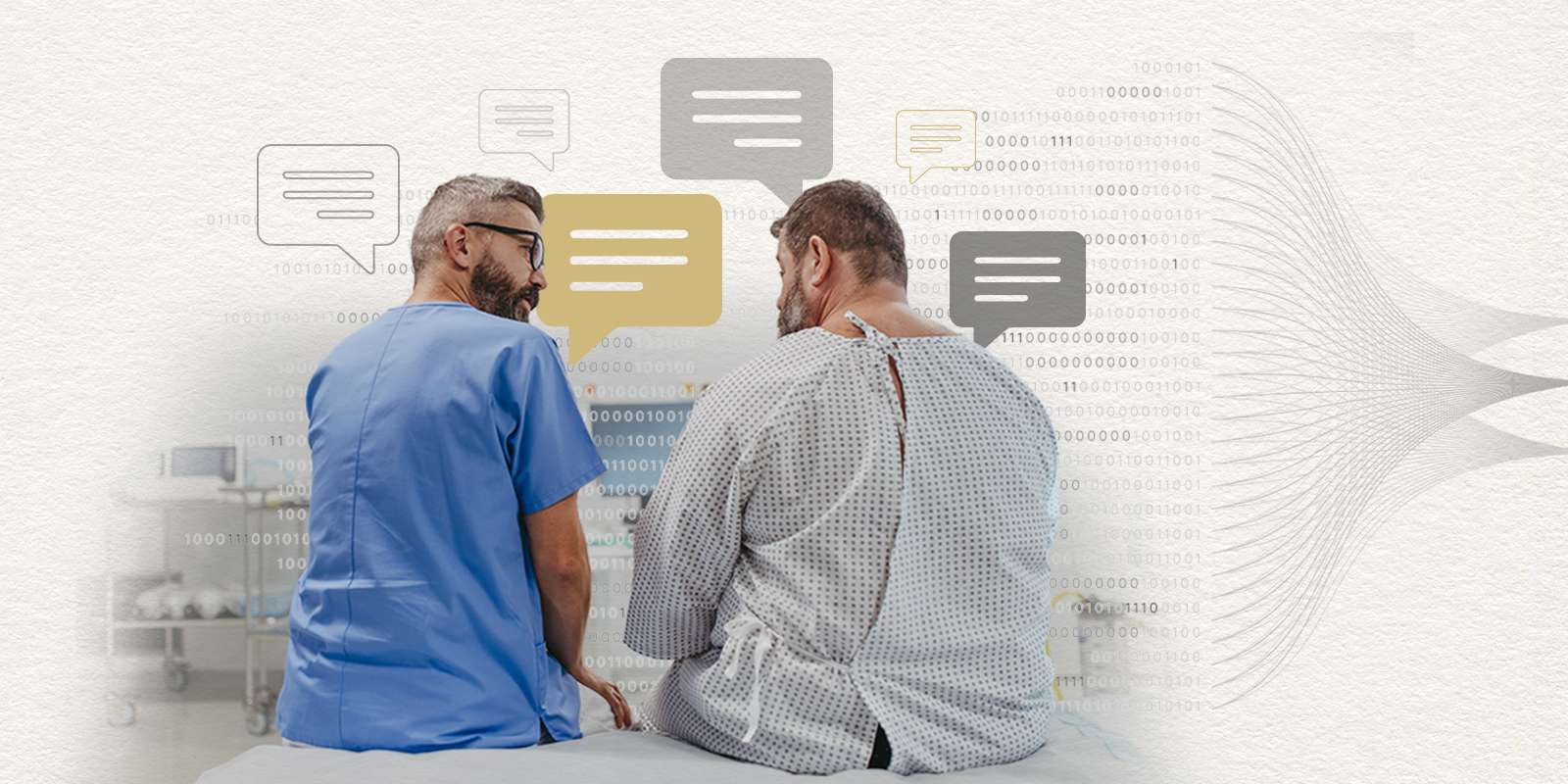
At top: Photo illustration by Jenn Green | CU Anschutz Department of Emergency Medicine.