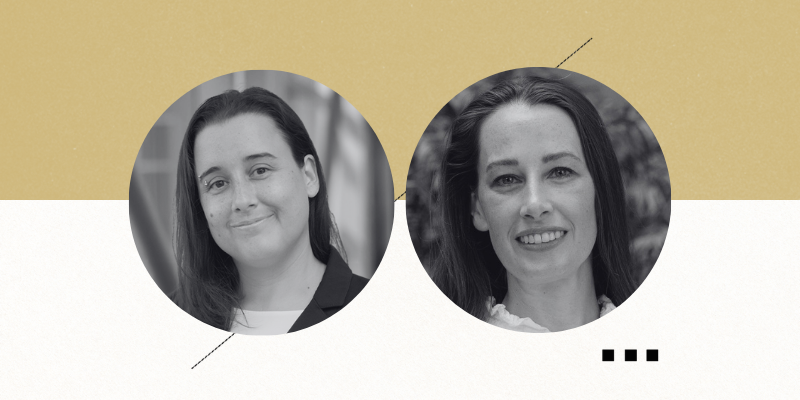
Two University of Colorado Anschutz School of Medicine faculty members have each been granted a National Institutes of Health (NIH) Director’s New Innovator Award for research projects that are highly innovative, impactful, and bold.
The awards, given to early-career investigators who propose high-risk, high-reward research, will allow Alessandra Brambati, PhD, assistant professor of pharmacology, to research the molecular mechanisms of DNA repair in neurons and Rowan Karvas, PhD, assistant professor of reproductive sciences in the Department of Obstetrics and Gynecology, the ability to delve further into understanding early development of the human placenta and critical pregnancy complications like preeclampsia.
“This award invests in my ideas and allows me to continue doing the science in areas where we’re more unsure of the outcomes,” says Brambati, who joined CU Anschutz in 2024. “It’s important in my work to have the right tools, but we must build them first. So, having the time and resources to do so makes a big difference.”
The same is true for Karvas, who has also been with CU Anschutz for two years.
“When you’re asking big scientific questions, you have to be open to lots of opportunities and lots of different ways of thinking about something,” Karvas says. “That’s what the New Innovator Awards provide: the flexibility to do the best science you can,” she says.
Brambati and Karvas are among 42 total projects from across the country and across disciplines chosen this year for the New Innovator Awards. They are part of the NIH’s High-Risk, High-Reward Research program “to support exceptionally innovative research with the potential for broad impact on biomedical and behavioral science.”
Funding for the award is provided by the NIH Common Fund, as well as two other NIH institutes and offices. Awards begin in 2026 and provide support for up to five years, pending the availability of funds.
Alessandra Brambati, PhD | RNA-templated DNA repair as a genome maintenance pathway in neurons
Nearly every cell in the body carries an instruction manual known as DNA. Sometimes that DNA breaks and instructions are lost. What happens next has been the focus of Brambati's research.
Most neurons in a person’s brain today will still be there decades from now. Unlike skin or blood cells, they are rarely replaced, so the DNA must be kept intact for a lifetime. Dividing cells can repair broken DNA using the duplicate copy they make before dividing. Neurons don't divide, so it's not possible to use a copy of DNA to restore those instructions.
During her postdoctoral training, Brambati and colleagues discovered that human cells can use RNA, a molecule that carries copies of genetic information, as a template to repair broken DNA.“It's like repairing a torn page using a photocopy of it” Brambati explains.
“We think this new repair strategy may be especially important for cells that don’t divide, like neurons, because DNA damage naturally builds up in the same places where RNA is most abundant,” she says. “If we can understand how it works, we might be able to prevent neurons from dying, help them to protect their DNA for even longer and eventually develop new strategies to treat diseases that currently have no cure.”
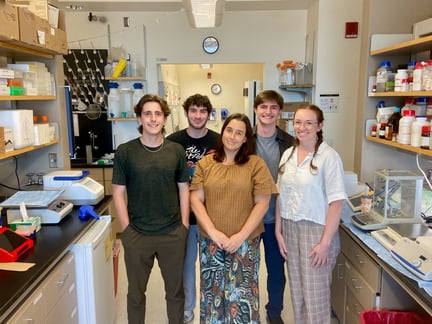
Alessandra Brambati, PhD, center, and staff members of her lab in the CU Anschutz Department of Pharmacology. Photo courtesy of Alessandra Brambati.
How non-dividing cells maintain their genomes over a lifetime remains poorly understood, Brambati says, partly because they are challenging to study. Most tools for measuring DNA repair were developed in dividing cells grown in a dish, and RNA-templated repair is especially hard to detect because the repaired DNA can look almost identical to the original. Neurons are also more vulnerable than most cells: they last as long as the person does, they are rarely replaced, and they accumulate DNA damage over time.
The NIH Director’s New Innovator Award allows Brambati and her CU Anschutz lab to build the molecular tools needed to study this repair mechanism in neurons, which could reveal new therapeutic targets for neurodegenerative diseases where DNA repair fails.
Rowan Karvas, PhD | Understanding early development of the human placenta: A crucial step toward solving the preeclampsia puzzle.
Preeclampsia, a hypertensive disorder characterized by a rapid rise in blood pressure during pregnancy, is a leading cause of maternal and infant illness and death. Researchers estimate it affects up to 8% of pregnancies worldwide.
While preeclampsia is believed to be caused by abnormal early placental development, it’s unclear what mechanisms underpin the development of the disease. It’s what Karvas and her lab at CU Anschutz are working to figure out.
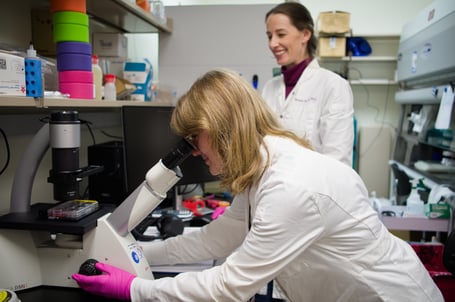
Post-doctoral fellow Julia Gundersen, center, works alongside Rowan Karvas, PhD, in the lab at the CU Anschutz Department of Obstetrics and Gynecology. Photo courtesy of Rowan Karvas.
“We're interested in how the early first trimester placenta — shortly after implantation — forms and develops. This is obviously a very inaccessible time of pregnancy for research, as you can imagine. A lot of women are completely unaware of their pregnancy at this point,” Karvas says. “We don’t have a lot of tissue samples to study from this point in pregnancy, so that really drove my motivation to develop in vitro models of early implantation.”
Creating and studying three-dimensional in vitro models, called trophoblast organoids, may reveal clues about the development of preeclampsia before symptoms even begin to occur, which typically happens at about 20 weeks.
“Our north star in my lab is really trying to solve preeclampsia. To get at that we must figure out what could initially cause it because that's unknown,” Karvas says. “I’m grateful to the NIH for having picked this project and making a commitment to women’s health.”