<img height="1" width="1" style="display:none" src="https://www.facebook.com/tr?id=799546403794687&amp;ev=PageView&amp;noscript=1">

Hearing Loss ‘Shrinks’ a Person’s World; CU Anschutz Opens It Back Up

From gene therapy to cochlear implants, ear specialists restore hearing through advanced research and care

minute read

by Debra Melani | August 27, 2025
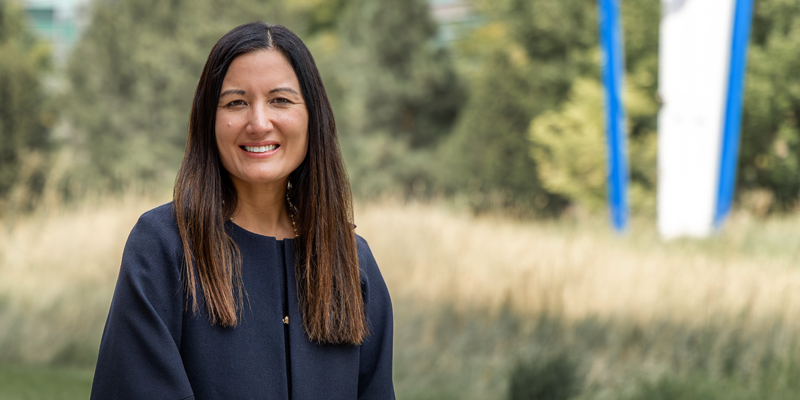
A portrait shot of Yuri Agrawal, MD, standing on campus with trees, grasses and a large blue-framed door art piece in the background

When she joined University of Colorado Anschutz two years ago, Yuri Agrawal, MD, knew it was a place where she could make things happen.

As she accepted the reins of the Department of Otolaryngology – Head & Neck Surgery at the CU Anschutz School of Medicine, Agrawal was aware of the work of Marion Downs, a longtime faculty member who, decades before, fought for hearing screening for all infants and won. Downs is now considered the pioneer of pediatric audiology.

It’s a legacy Agrawal works to honor by continuing the department’s mission of discovering and providing life-changing care.

“We deal with very human aspects of life,” Agrawal said. “Being able to hear, speak, smell and make facial expressions are the things that define us as humans.”

Never Dream Alone, a newly launched advertising campaign, highlights the work of Yuri Agrawal, MD, and her team along with other members of the CU Anschutz community. A special project done in collaboration with the Colorado Symphony, the ad campaign underscores how great things come when people work together. See related stories:

Agrawal gained a broad appreciation of communication’s social, educational and cultural impacts growing up in Canada, learning to speak the native languages of her country (English and French) and of her parents (Japanese and Hindi).

While her training and expertise cover everything from ringing in the ears to cancer of the neck, Agrawal specialized in otology and neurotology, an area focused on disorders of the ear and of the nerves that connect the ear to the brain.

Below, she shares more about two goals related to her specialty area – gene therapy and the cochlear implant, which she calls a “miracle” of medical progress as the first tool to completely replace a lost sense through direct stimulation of the brain. 

Q&A Header

Would you share more about your work related to cochlear implants?

Our team works to improve access, refine the technology and increase our ability to perform the surgery effectively and efficiently. We already do most of the infant and child implants in the state at Children's Hospital Colorado, and I think there's a huge opportunity for us to continue to provide that service comprehensively throughout the age range, both at Children's and UCHealth University of Colorado Hospital and our affiliated sites throughout Denver.

Initially, cochlear implants were indicated only for total deafness: babies born deaf or older people who became completely deaf. But there's a vast area in between – where people have some residual hearing but it's not what we would call functional or serviceable hearing – where patients can benefit from implants because they improve their ability to communicate. We can now offer cochlear implants to those individuals. We can implant babies as young as 9 months, and we've implanted somebody who was 102.

Also initially, cochlear implants were these giant devices that required a five-day inpatient hospitalization, and now we can do the procedure comfortably in an hour in an ambulatory surgery center. Having the main manufacturer based in Denver provides a pathway for evaluating early-to-market technology – such as a totally implantable cochlear implant – which is now in early clinical trials. (Current technology involves an external piece positioned behind the ear.) 

Looking ahead, what is something else in the profession that excites you?

Gene therapy is one of the really exciting areas in our field, with hearing loss having one of the few effective gene therapy proofs of concept that exist right now. With gene therapy, a vector (generally a harmless virus) is used to deliver a working copy of the gene into the inner ear, where it enters the cells and restores their ability to transmit sound signals to the brain. 

One gene that causes a defect in a certain part of the cochlea in the inner ear has been identified, and five different groups have developed a gene therapy that reverses the hearing loss for that specific condition. It's not a very common type of hearing loss, but now the race is on to try to develop gene-therapy approaches to more complex and common causes of genetic hearing loss.

In Colorado, we already genetically test most of the kids with hearing loss in the state. So we are very well-positioned to identify all the causes of genetic mutations for hearing loss that are occurring in babies that are born deaf. And we're building our repository of the different genetic signatures of hearing loss, also positioning ourselves to easily deploy tools once they are developed. 

How does being a part of the CU Anschutz community influence your goals?

Besides being a premier center in the state for taking care of the hearing healthcare needs of the citizens of Colorado, I think our goal as an academic center is filling knowledge gaps for our field and contributing to the innovation of therapies and the care of patients everywhere. And CU Anschutz is a really great place to develop a lot of these ideas.

A lot of the research infrastructure in place and the departments that we're building, such as Biomedical Informatics, allow for forging collaborations and thinking about problems in new ways. Clearly, gene therapy is part of the future of ENT (ear, nose and throat) medicine, and having the potential to collaborate with the Gates Institute and the Gates Biomanufacturing Facility (national leaders in cell and gene therapy on campus) is incredibly exciting.

People are just very open to collaborating here, and we have a motivated leadership trying to grow, improve and propel us into the top 10 of medical research institutions. I think that’s helped us attract a lot of new talent to the campus to bring our medical fields forward. We’ve just seen incredible support for the work that we're trying to do, and there’s a real energy here. 

Why is this work important to you?

If you don't have enough hearing that you can communicate effectively with people in your social life, then you start to retreat from social activities, and your world ends up shrinking. And with that, you're losing the interaction and stimulation that you need not only to be social but also to keep your mind active. There is a lot of compelling research that connects hearing loss to cognitive impairment and the onset of conditions like Alzheimer's disease (another key area of research focus for Agrawal).

Addressing hearing loss in infants is even more vitally important to tap into the critical periods of neural development that then inform speech development. It was audiologists in our department in the ’50s, led by Marion Downs, who generated the evidence that set the standard for early intervention. That's now replicated everywhere. I want us to continue with that legacy and lead in innovation and hearing healthcare.

Note: This interview was edited for length and clarity. 

Featured Experts
Staff Mention

Yuri Agrawal, MD