What are the major parts and components that make up a transtibial bone anchored limb (osseointegration)?
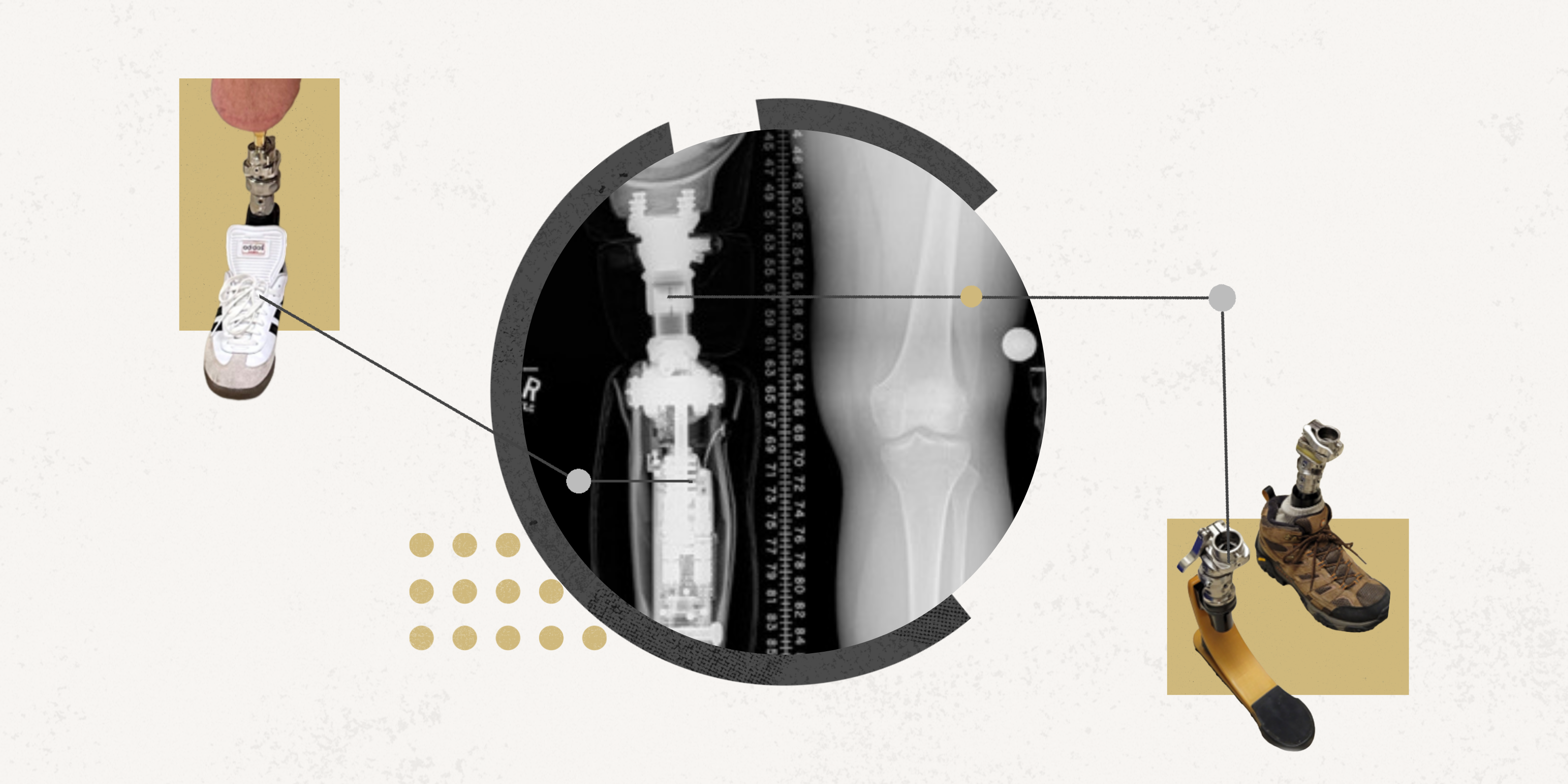
Inside of the body, there's an intramedullary (the cavity inside a bone) implant and a percutaneous adapter that sticks out through the skin. That's what the prosthesis actually connects onto.
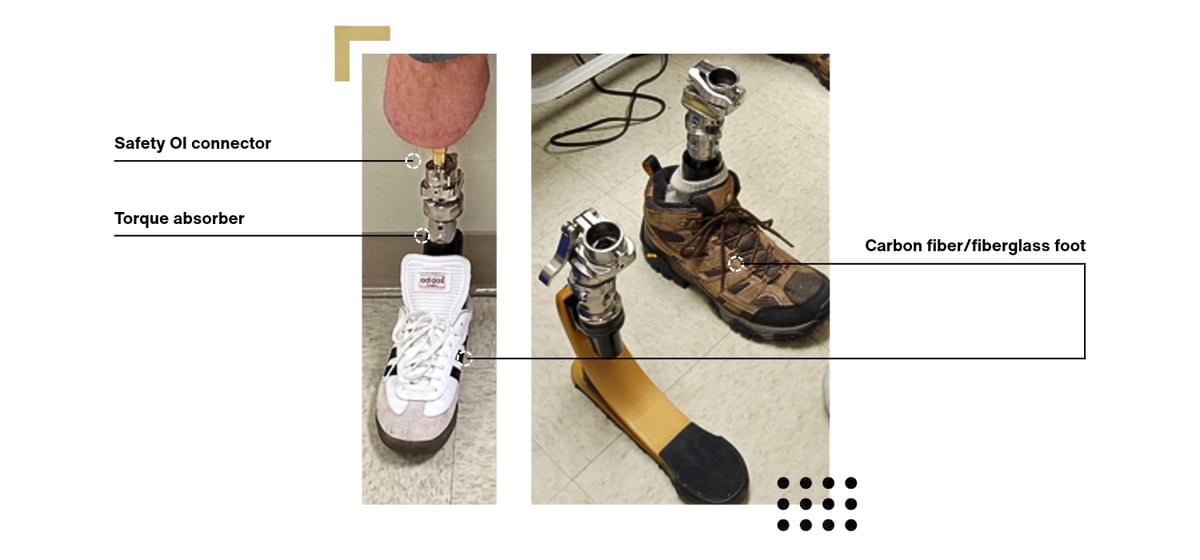
And then outside of the body, there's typically some sort of safety connector or adapter. This is designed to disconnect in the event that high loads are applied, which helps to protect the implant from transferring these forces into the bone and potentially causing a fracture.
After that, the rest of the prosthetic componentry is pretty similar to a standard socket prosthesis. So for someone with a transtibial amputation, this will be a prosthetic ankle and foot, possibly an adapter and a pylon.
What is a Delphi Consensus, how does it work and eventually lead to clinical guidelines for providers?
A Delphi Consensus is an iterative and anonymous process that’s used to develop a foundational alignment among a panel of experts. It typically includes several rounds of surveys where respondents will vote or provide responses on assumptions or an inventory of knowledge on a given topic, provided by the group running the study. The collected results are then given back out to the group to put together a list of priorities.
Earley describes how it’s a helpful first step.
“For us, in the absence of the scientific evidence, or any other recommendations that existed, that was why we wanted to generate this consensus in the first place,” he said. “It's a process that’s iterative, it's anonymized, so it reduces some of the bias of seniority and people can see what others are thinking on the topic and adjust their decisions accordingly.”
The next step? Research.
“We have to see where these recommendations hold up or need to be recalibrated in the wake of more evidence,” Earley said. “And when both of those pieces are in place, that is when clinical practice guidelines can be proposed. Patient safety is always the top priority.”
Why are developing recommendations on prosthetic components for patients with transtibial bone-anchored limbs important?
It’s a challenge because prosthetic care is so individualized, but one big influence on us running this study is that the current recommendations for prosthetic componentry assume a socket prosthesis by default.
What we were trying to do is to test those assumptions to demonstrate where those recommendations can be transferred to this new population for bone-anchored prosthetic limbs.
And more importantly, we wanted to identify the areas where there are different considerations to be had and to formally document that. Right now, a lot of prosthetic care for bone-anchored limbs is based on providers being thrown into the deep end – learning from experience or learning from other prosthetists.
The main recommendations that were agreed upon by the delegates were that transtibial bone-anchored limb components should include three items: a safety connector, torque absorber and carbon-fiber split toe. Why were those agreed upon?
Most of the manufacturers for these implants require the safety connector, so prosthetists are not going to move away from that without manufacturers’ approval. One of the biggest considerations with bone-anchored limbs is protecting the bone from inadvertent forces and torques. That's why the torque absorber was recommended to really try to reduce forces transferred into the bone.
The safety connector itself acts like a ski binding – if too much force is applied, it will separate. Much like a ski binding, there is a Goldilocks zone that you're trying to achieve.
If the threshold is too low: the risk is that the prosthetic foot will disconnect unexpectedly resulting in a fall or a potential injury for the patient – for example, maybe while stepping off of a curb.
If that threshold is too high: the risk is that a high force is transferred directly into the implant and can cause damage or fracture to the bone.
These are critical for patient safety. It is also an area of a lot of discussion within the field as to how best to set that threshold.
Earley also worked with CU Anschutz colleagues on a previous, related studies for the field in general and a partner study on transfemoral bone anchored limbs.
Why did the recommendations include a carbon-fiber foot?
The carbon-fiber prosthesis is a pretty widely used prosthetic foot. We presented a lot of different types of feet and had Delegates rank or evaluate each one separately. Very simple feet, like a SACH foot, which stands for solid ankle cushion heel, were generally not recommended for these patients.
Prosthetic feet typically look like a smaller version of the running blades, which you may see for Paralympic athletes. It's basically some sort of springy material, carbon fiber or Fiberglas, that when you step down, it will sort of act like a spring. And when you're walking, it helps to propel you forward by absorbing energy as you put weight onto it and then releasing that energy when you step off. Different materials – like carbon fiber – just provide different stiffness properties.
Was there anything the consensus advised against?
On the other side, robotic ankles or microprocessor-controlled ankles were typically not recommended, although we didn’t reach consensus recommending against their use either.
Powered ankles create powered plantarflexion during walking. For individuals with a socket prosthesis, this can help with walking with the intent to reduce metabolic expenditure, less energy use while walking and help with stairs. But with a bone-anchored prosthesis, there's a concern about adding additional forces into the prosthesis for the reason of protecting the bone from inadvertent forces.
But that will take dedicated studies and research to demonstrate the benefit before prosthetists and manufacturers approve the use of these devices that work with a socket prosthesis.
Why do we need recommendations on these components?
There are gaps we need to fill in for providers to standardize the process across health systems in order to receive uniform training, while giving the best care to their patients.
For example, we looked at the recommendations for socket prostheses that existed in the literature – specifically provided by the Department of Veterans Affairs and the Department of Defense. They have some recommendations, but are missing other items – for example, shock absorbers and torque absorbers don't show up. Whereas it was a frequent point of conversation during our Delphi study.
Where does this research go in the future?
There are a lot of patient guidelines that currently exist with osseointegration that are proposed out of an abundance of caution – like limiting high-impact activity such as running or weightlifting.
On the topic of rehabilitation, for example, we showed consensus in the recommendation to include a torque absorber, but we also had delegates who indicated times when that torque absorber may actually be affecting their rehab.
The Bone-Anchored Limb Research Group has studies showing that there is some reversal of muscle atrophy walking with a bone-anchored limb. In Brecca Gaffney’s work using biomechanical models and imaging, she shows changes in dynamic muscle forces with a bone-anchored limb, as many of these patients may be using these muscles more than they had with a socket. These changes happen over time, so prosthetists often need to work frequently with these patients to create incremental changes to alignment or angles in the prosthetics.
Addressing such gaps is foundational to setting the stage for future clinical guidelines.
Key points:
-
CU Anschutz researchers developed consensus recommendations for components used in below-the-knee bone-anchored prosthetic limbs, helping lay the groundwork for future clinical guidelines.
-
Three prosthetic components were recommended: a safety connector, torque absorber and carbon-fiber split-toe foot to support mobility and protect patients from excessive forces on the bone.
-
Additional research is essential to validate the recommendations, improve rehabilitation approaches and establish evidence-based clinical guidelines for individualized patient care.