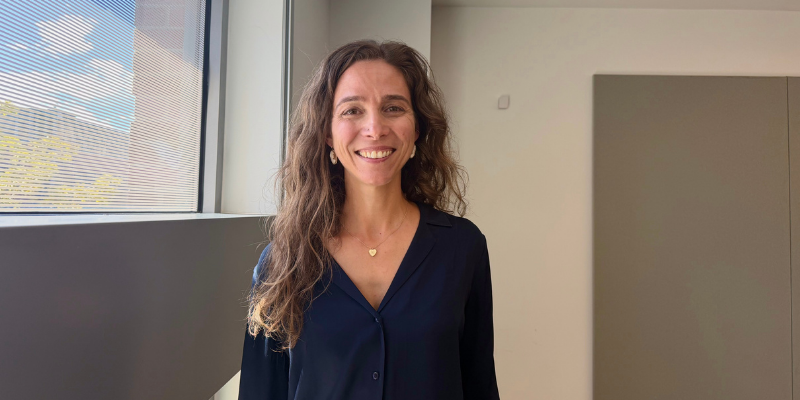
When Baylie Thurber started the Family Nurse Practitioner (FNP) program at the University of Colorado Anschutz College of Nursing, she went looking for someone who’d already been where she was headed.
“It's always been really important to me to seek out people smarter than me and more experienced than me, and so this was just an easy thing, and I was very grateful to be a part of it,” Thurber says.
She was paired with a mentor of her own — a relationship, she says, that helped guide her education and gave her a friend. Today, Thurber co-leads MINGLE (mentorship, information, networking, growth, learning, engagement), the college’s peer mentorship program for FNP and Adult-Gerontology Primary Care Nurse Practitioner (AGPCNP) students.
MINGLE pairs incoming students with mentors at least one semester ahead, offering guidance on clinical rotations, work-life balance, and how to adjust to hybrid learning. Launched in 2017 as a collaboration between Dr. Krista Estes and then-FNP student Christopher Flom, the program has run every year since. It prioritizes new students, though any cohort can request a match.
Now, Thurber has been leading the program, matching students together, leading information sessions and events, and hosting networking events.
Her co-lead, Heather Mauceri, is an AGPCNP student. When Heather arrived at the college, she found the mentorship program hadn’t been established for her program yet. After years in the workforce, coming back to the classroom felt daunting, so she looked for guidance as she began the program.
“One of the things that I found lacking with a new school and a new program was I didn't know who to ask that was a year ahead of me,” Mauceri says.
Mauceri and Thurber became friends and decided to join forces to bring AGPCNP students into the program.
“I knew I would benefit from it. I thought others would as well. I handle the matching for the AGACNP program, and she does the FNP, and then we share events and lunch-and-learns,” Mauceri says.
MINGLE is a voluntary program and the mentor and mentee can choose to be as involved as they want.
“I make the connection and then it’s on them to reach out. We tell them this relationship can be anything you want it to be,” she says. “My mentor and I became really good friends, but it also can just be something where once a semester your mentor checks in and asks ‘Hey, you doing good?’”
She says the relationship can be a good way for new students to learn about course difficulty, professor style and professional development.
“It’s somebody that you can ask the questions to, somebody that's done this before. There's a lot of angst around the unknown,” Thurber says.
Network, Learn, and Succeed
Networking is also a core mission of MINGLE. Thurber and Mauceri host social events that give students a chance to network with others outside of their cohort. This semester they are also hoping to include all graduate nursing students to these events.
Thurber says having connections with nurses in other fields will be beneficial in their future work.
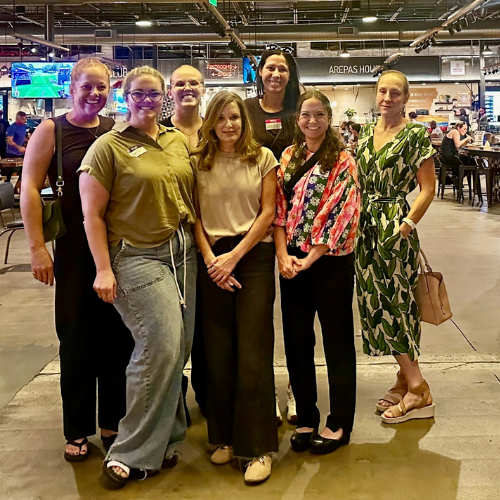
Baylie Thurber (front left) and Heather Mauceri (front middle) stand with their peers at a networking event in Denver. |
“Someday when I'm in primary care and Heather's in hematology or something, I can reach out and ask her to review a patient issue. Like drive-by nurse practitioner consults. So it just really helps to strengthen that community,” Thurber says.
In addition to the mentorship and networking aspects, the program also hosts Lunch and Learns, where faculty or experts discuss topics not always covered in class.
“The Lunch and Learns are an opportunity for us to provide some education that is low stress, you don't have to come, there's no test at the end of it,” Thurber says. “The topics are maybe specific areas that we don't get a lot of, or we're not going to learn about necessarily in school because there's just too much to know.”
Thurber says these sessions, events and mentoring partnerships help further nurse education, and she says that's what the MINGLE program is all about. She says it’s a resource students can access to become better students and better future nurses.
“Grad school, nursing, and learning to become a nurse practitioner is hard,” she says. “And I want this mentor program to help build the nursing community and strengthen our profession.”
Students interested in joining MINGLE can email Baylie Thurber and Heather Mauceri for more information.