When John Harper walks the halls of the Rocky Mountain Lions Eye Institute, a 135,000-square-foot building on the University of Colorado Anschutz Medical Campus, he’s not just struck by the innovative eye health care being provided. He also sees years of embedded history, remembering the work that he and others put into opening the building nearly 25 years ago.
“It’s a fun history to walk in there and be able to tell people, ‘Do you see that wall over there? I helped pick that color,’” says Harper, president of the Rocky Mountain Lions Eye Institute Foundation.
The foundation was created in 1991 by some members of Lions Clubs International — an organization that is made up of 49,000 local Lions clubs across the globe. In the 1980s, Lions members in Colorado and Wyoming recognized a need for more comprehensive eye health care in the Rocky Mountain region, because many residents had to travel as far as the east coast to get specialized care. Driven to help, the members partnered with CU leaders to establish a new building named the Rocky Mountain Lions Eye Institute.
In the years since the building’s opening in 2001, Harper and other Lions members have continued to support the mission and vision of the eye institute, now known as the Sue Anschutz-Rodgers Eye Center, which is headquartered in the Rocky Mountain Lions Eye Institute. The foundation has contributed more than $7 million to help the center evolve and expand its services and reach. Today, as the only academic eye center in a 500-mile radius, more than 114,000 patients visit the facility each year.
“The Rocky Mountain Lions Eye Institute Foundation has been instrumental in the growth of the CU Department of Ophthalmology over the past 30 years,” says Naresh Mandava, MD, chair of the department and the Sue Anschutz-Rodgers Endowed Chair in Retinal Diseases. “Over 177,500 patient visits and almost 10,000 procedures occur at the eye center annually. All of this would not have been possible without the tremendous support of the Rocky Mountain Lions.”
‘Where my passion is’
The Lions Clubs International organization dates back to 1917, with local clubs being established across the globe. In 1925, Helen Keller spoke at an international convention and challenged the Lions members to be “knights of the blind” by focusing their work on preventing vision loss — a mission that continues a century later.
For Harper, the mission is personal. Growing up in Cheyenne, Wyoming, he remembers when local Lions Club members would visit the home of his grandmother, who was blind, to help her go on walks, teach her how to use a cane, help her cook, and perform other household tasks.
“I saw what the Lions did for my grandmother, and this is my way of payback — to become involved in this,” he says. “This is where my passion is.”
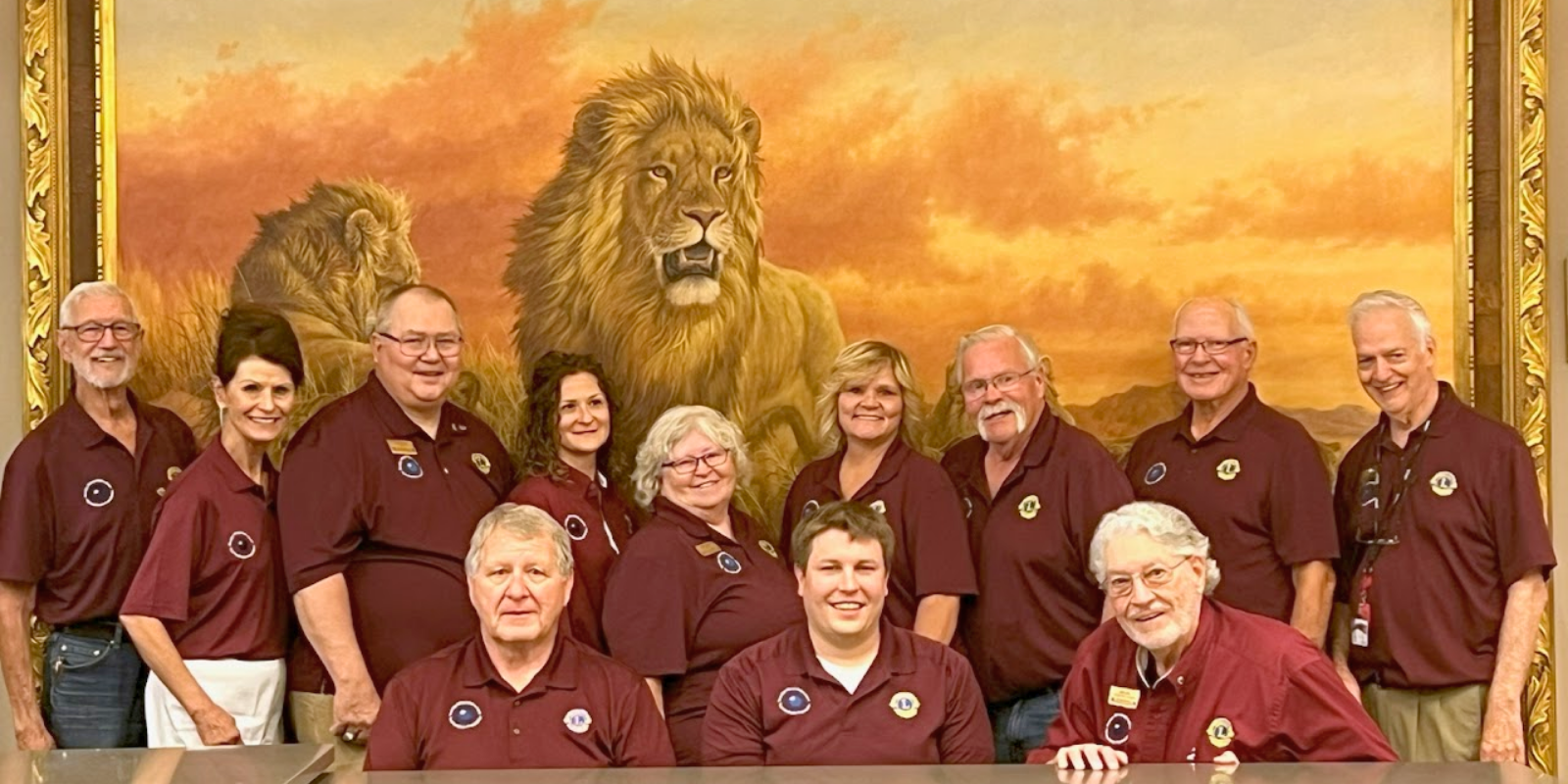
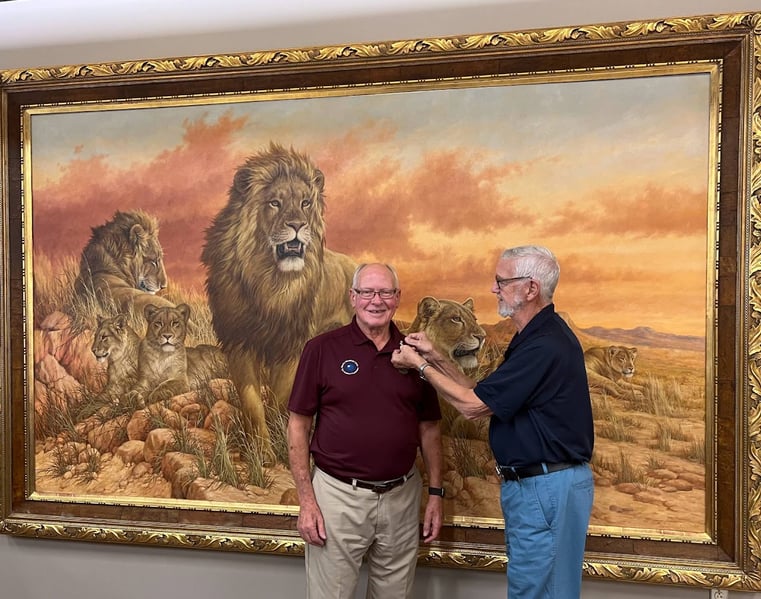 Former International Director Ken Schwols places a pin on John Harper, president of the Rocky Mountain Lions Eye Institute Foundation, in the lobby of the eye institute building in July 2023. Image courtesy of Harper.
Envisioning and evolving care
Inspired by stories of other Lions clubs helping create eye institutes and vision centers across the nation, several members of the Lions Club of Denver began working in the late 1980s to partner with CU’s existing Department of Ophthalmology to develop a new eye institute. They invited other Lions members from different clubs in Colorado and Wyoming to join the effort, officially forming the Rocky Mountain Lions Eye Institute Foundation in 1991.
It took roughly 12 years to raise $6 million to help build the eye institute. Mandava says the Department of Ophthalmology is grateful for the collaboration between the foundation and the previous chairs of the department, J. Bronwyn Bateman, MD, and Philip Ellis, MD, who he explains were instrumental in working with the foundation to see the building’s completion in 2001.
“Anytime I go on a tour of the building, people are so gracious about thanking the Lions for what we have done,” Harper says.
The partnership did not end once the building opened in 2001. Rather, the foundation and CU continued to collaborate to further innovate and enhance the services being offered at the eye institute. In 2015, they celebrated the completion of an expansion project that nearly tripled the size of the institute from 48,000 to 135,000 square feet. By coordinating with the Lions Clubs International Foundation, the Rocky Mountain Lions Eye Institute Foundation was able to contribute $1.3 million to that project. The foundation has also contributed hundreds of thousands of dollars to enhance the Sue Anschutz-Rodgers Eye Center’s examination rooms and help purchase top-notch equipment.
“There are so many patients being served here and impressive research going on, including looking at how to do full eye transplants,” Harper says. “We were there from the beginning to offer support — and look at what it started. This is such a wonderful thing we’ve helped create, and we plan to continue helping as much as we can.”
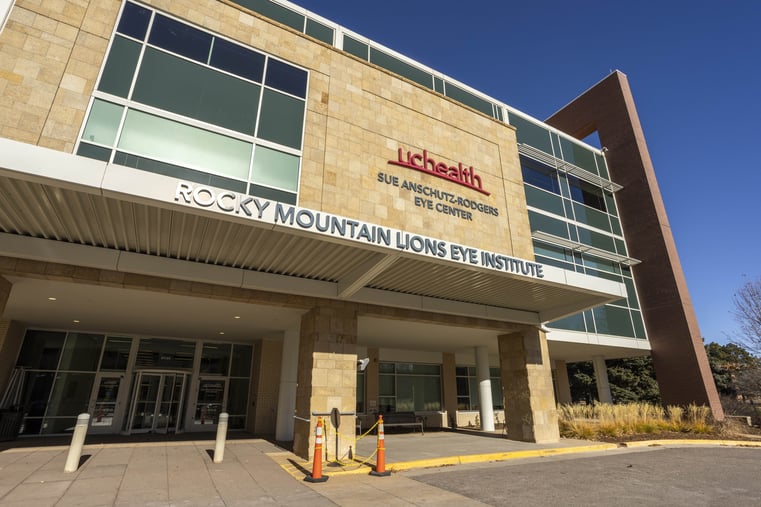 The Rocky Mountain Lions Eye Institute building houses the Sue Anschutz-Rodgers Eye Center.
‘Worth all the effort’
Beyond supporting the expansion of the facility and its equipment, the Rocky Mountain Lions Eye Institute Foundation aims to help patients afford the eye health care services they need.
For example, the foundation had helped cover some costs for patients with low vision, a condition where patients have vision loss that cannot be corrected with conventional glasses, contact lenses, medication, or surgery. The eye center has a low vision rehabilitation service where providers can offer patients a trial frame refraction — a testing method to determine the visual potential in patients. Although it is a valuable assessment to perform during a patient’s initial evaluation, trial frame refraction is not covered by insurance and can be cost prohibitive. But donations made by the foundation have helped more than 400 patients access these assessments over the years.
The foundation also provides financial assistance to local Lions clubs to support patients who have to travel longer distances to access eye health care services. For instance, Harper knows of a Lions member from a rural area of Wyoming who needed cataract surgery in both eyes and received travel funds so he could come to Colorado.
“Because of the eye center, the man can see now,” Harper says. “I know there are many people who are receiving services that are extremely difficult and can't be served at the local level. They need a place like the eye institute to be able to go to.”
He knows of another child from Cody, Wyoming, who had a traumatic eye injury who had to travel to Colorado to get care.
“The doctors at the University of Colorado Anschutz Medical Campus saved that child’s eye. For me, that was worth all the effort I’ve put into this — helping that one kid,” he says. “The foundation’s work is important because we want to help people’s eyesight be saved or restored. I know that there is a need for us, and every dollar we contribute helps support the mission.”
As the leader of the Department of Ophthalmology for more than 20 years, and a CU faculty member before that, Mandava has worked alongside Lions members like Harper for nearly three decades.
“I am grateful for them, and those who are no longer with us, who were deeply committed to developing our programs,” Mandava says. “I think they would be proud if they saw what we have accomplished.”