As an artist, Diane Ciampa’s eyesight is invaluable to her, allowing her to see and capture the surrounding world through her drawings and paintings. But on a winter day in 2018, a roller hockey accident almost led to her losing an eyeball — that is, until she connected with ophthalmologist Scott Oliver, MD, at the Sue Anschutz-Rodgers Eye Center at the University of Colorado Anschutz.
“He’s my hero because he saved my eye,” says Ciampa, a 65-year-old artist living in Colorado Springs. “I’ve drawn all these beautiful things since this has happened. It hasn’t stopped me from being an artist.”
To show her gratitude, Ciampa has created several art pieces for Oliver. One of them, a pencil drawing, depicts a person’s eyeball, and within the eye, there are several symbols of the eye center. In the iris, there is an outside view of the Rocky Mountain Lions Eye Institute, the building where the eye center is headquartered. A lion, with its mouth slightly ajar, is seen within the pupil of the eye. The artwork is meant to represent the patient’s perspective, she explains.


“The lion is looking at the patient, and the patient sees both the lion and the overall eye center,” Ciampa says, adding that there is a small Batman signal tucked into the drawing as well. “That was my way of showing Dr. Oliver that he’s my hero.”
The framed drawing is proudly displayed outside of Oliver’s office at the Sue Anschutz-Rodgers Eye Center. Another art piece he received from Ciampa, an oil pastel drawing of an eye, hangs in his secondary office in Denver. They serve as reminders to himself, colleagues, and patients of the transformative work being done by ophthalmologists.
“I was really touched. It shows her appreciation for the institution — because it wasn’t just me. It was our whole team, including our operation room staff, clinical staff, and other surgeons. She really understood that,” says Oliver, professor and chief of retina service at the CU Anschutz Department of Ophthalmology. “The artwork helps me tell other patients her story. Her case solidified my resolve that every eye deserves a chance.”
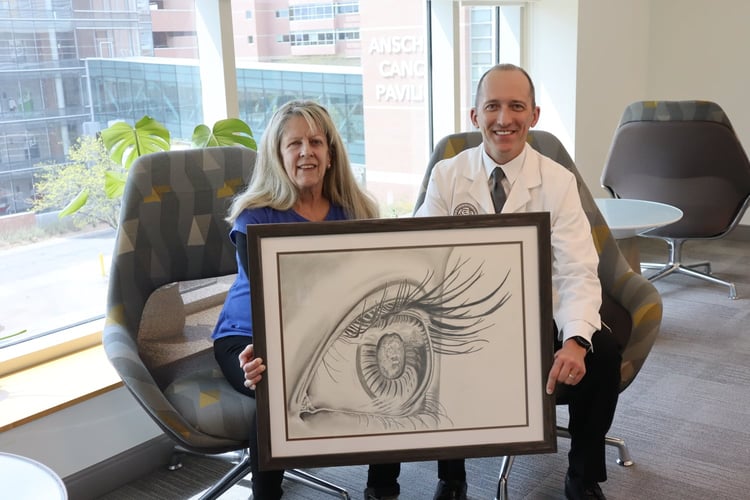
Diane Ciampa and Scott Oliver, MD, hold up one of the art pieces that Ciampa has created, which is on display at the Sue Anschutz-Rodgers Eye Center. Image by Tayler Shaw.
A life-changing accident
On December 21, 2018, Ciampa intended to spend the day working on a drawing, but the persuasiveness of her husband, who wanted to play roller hockey, and the appeal of a sunny day lured her to trade in her pencils for roller skates and head to a skating park.
With music playing in her earbuds, Ciampa was skating around the park when, in a flash, her life changed. Her husband had shot a plastic puck toward a goal post, and the puck hit the top of the post’s crossbar. The puck ricocheted in the direction of Ciampa, hitting her right eye and causing it to rupture.
“It happened so fast,” she says. “I fell right down. I didn’t know what happened and didn’t have much feeling, but there was a lot of blood. I knew something was wrong because I couldn’t see.”
Ciampa and her husband rushed to a nearby urgent care, and she was taken by ambulance to an ophthalmologist in downtown Colorado Springs. Her eye had been pushed back into the socket, and the cornea — which is the clear, dome-shaped surface covering the front of the eye — had ruptured open. Her other eye, thankfully, was unharmed.
Ophthalmologists in Colorado Springs performed emergency surgery to repair the rupture as much as possible, putting sutures in her eye. By January, however, Ciampa was still unable to see out of the eye, and after several weeks and follow-up appointments, her ophthalmologist recommended enucleation — the surgical removal of the entire eye, which is then typically replaced with a temporary implant before eventually being swapped with a permanent prosthetic eye.
“I was not interested in that,” Ciampa says. “I knew I had to act fast.”
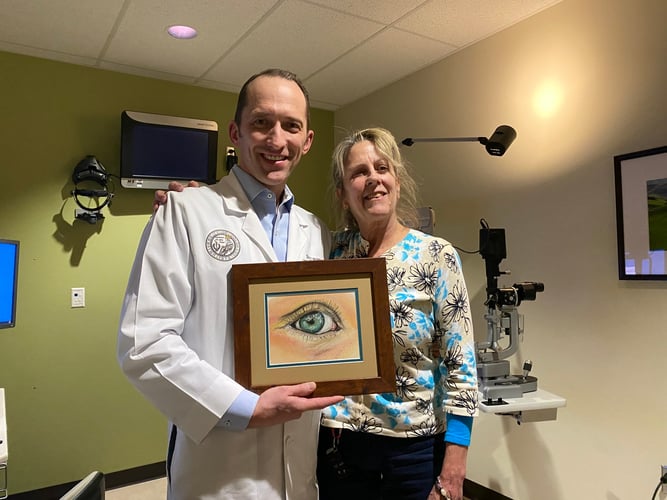
Diane Ciampa created an oil pastel drawing of an eye, which is on display in Scott Oliver's secondary office in Denver. Image courtesy of Ciampa.
‘He gave me hope’
Knowing she wanted other options, a different doctor recommended that Ciampa reach out to Oliver, a vitreoretinal surgeon at CU Anschutz. She had her first appointment with him on February 5, 2019, and by the end of the appointment, she was scheduled for surgery the next day — not to remove her eye, but to try to save it.
“When I met him, I was feeling anxious, but I had heard a lot of great things about Dr. Oliver,” she says. “He gave me hope.”
Deciding whether to enucleate is complex, explains Oliver, the Vitale-Schlessman Endowed Chair in Retinal Diseases. Historically, it was thought that if the eye loses all sensitivity to light, then it is likely unsalvageable. However, Oliver says that in some instances, it is appropriate to operate, because there may be a reason the eye has lost light sensation, such as severe bleeding inside the eye or retinal detachment, and ophthalmologists can potentially bring some vision back.
“You cannot jump to conclusions,” Oliver says. “When you’re looking at a severely traumatized eye with disorganized contents, it certainly is intimidating. We tell patients it will be a major project over months to years, likely with multiple surgeries, to give the eye a chance. It’s normal for the patient to be scared and overwhelmed, so we have to take the time to guide them through a very long road.”
In Ciampa’s case, Oliver noticed that her eye “was severely ill and beginning to shrivel” with hardly any detectable vision. The sutures across her cornea, which he describes as “the front windshield of the eye,” made it impossible for him to see details inside the eye.
“When an eye is ruptured, sometimes there are parts of the eye that come out, so you don’t always know what is left inside,” he says. “By the time I saw her, the clock had already started ticking. The longer we wait, the more damage that occurs, such as internal scar tissue that can make the eye shrivel and eventually die.”
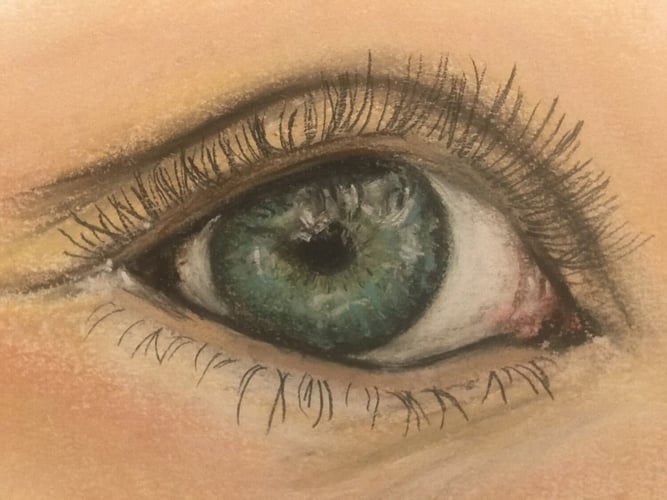
A close-up visual of the oil pastel drawing that Diane Ciampa created. Image courtesy of Ciampa.
‘I could see’
The next day, Oliver and other surgeons from multiple ophthalmology subspecialties at the Sue Anschutz-Rodgers Eye Center worked together to perform surgery. This included a cornea transplant, where Ciampa’s damaged cornea was removed and replaced.
“The transplant essentially gave us a new window into the eye so we could assess the damage and work on repairing the eye,” Oliver says.
Oliver and the surgeons saw that the iris, which is the colored part of the eye, was damaged and needed to be reconstructed. The lens of the eye also had to be removed.
“We worked our way deeper in the eye and navigated through blood, which is sort of like finding something that fell into muddy water. You must tread very carefully until you reach the retina,” he says.
The retina, Oliver’s area of specialty, is a layer of tissue near the back of the eyeball that detects light and transmits visual information from the eye to the brain. He saw that Ciampa’s retina was detached.
“The retina is like wallpaper lining in the back of the eye, so we have to float and manipulate the tissue so that it goes back up against the back wall of the eye,” he says. “We repositioned the retina and used a laser to spot weld it in place. Then, we put a silicone oil bubble in the eye to hold everything in position while healing occurs.”
When Ciampa woke up from surgery, she says she began “freaking out.”
“I could see,” she says. “I was able to see the largest letter on the eye chart across the room. I was so excited.”
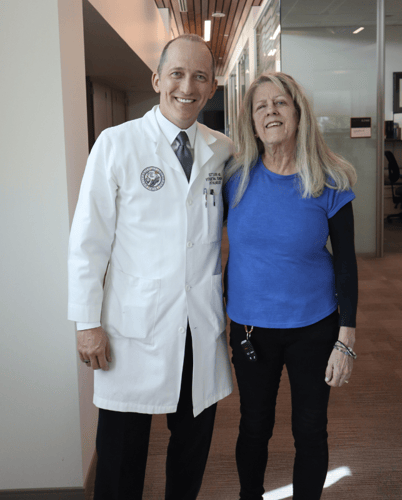
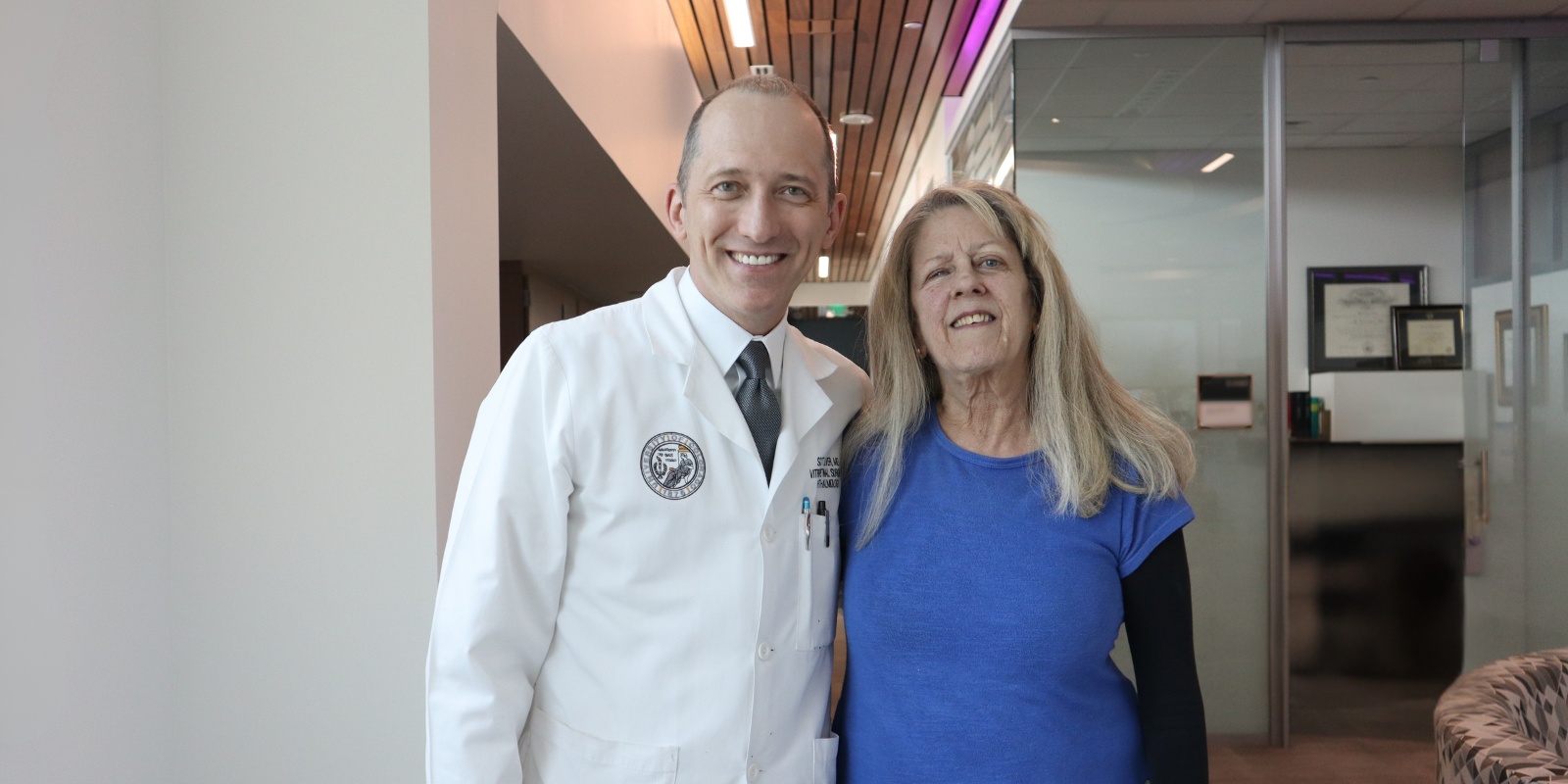
Scott Oliver, MD, and Diane Ciampa smile together at the Sue Anschutz-Rodgers Eye Center. Image by Tayler Shaw.
Helping patients ‘get their life back’
Ciampa had one last surgery ahead of her, which occurred on October 23, 2019, to remove the oil bubble in her eye, as it cannot be left in the eye for extensive periods of time, and perform some additional repairs on the retina.
Following that surgery, her new cornea became a bit sicker and she lost some vision, but she is still able to see shadows, colors, and shapes.
“Dr. Oliver helped save my peripheral vision, and I still have my eye,” she says. “He’s brilliant. And still, he can come down to my level and talk. His bedside manner is amazing.”
Since those surgeries, Ciampa has maintained an attached retina and appropriate eye pressure. Her other eye has 20/20 vision, and the eyes are not in conflict with one another. She continues to see Oliver every one-to-two years.
“She is in a stable place, and that’s really important for my patients with these severely traumatized eyes. Early on, the work to save and repair the eye often dominates their life, with frequent appointments and multiple surgeries,” he says. “Our goal is to help them get their life back. And now, she’s able to do the things she loves, like making art.”
When Ciampa gave Oliver the drawing of a lion within an eye, she asked that he share the artwork with everyone who helped her.
“To see that she went out of her way to do something so personal, thoughtful, and intentional, it’s really special,” Oliver says. “The fact that she wanted to tell other people her story through this art is very meaningful.”
A key lesson Ciampa wants people to learn from her experience is the importance of wearing safety gear, such as protective eyewear, when doing activities like skating or playing sports.
“You never think something like this is going to happen to you,” she says. “A freak accident happened to me, and I found the best doctor in the world to help fix it.”