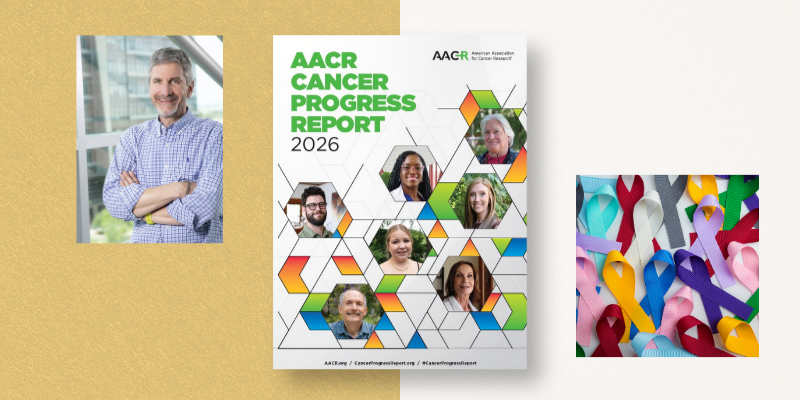
Real and substantial progress is being made against cancer, but that progress has been uneven, new potential risks are emerging, and uncertainty has grown about the stability of research funding, says a new report from the American Association for Cancer Research (AACR).
James DeGregori, PhD, interim director of the University of Colorado Anschutz Cancer Center, is one of several representatives of the nation’s top cancer research institutions on the steering committee for the AACR’s 2026 Cancer Progress Report.
“They relied on us to suggest what important topics, issues, and discoveries should be covered in the report, and then we reviewed multiple drafts of the report that were written by the AACR staff,” says DeGregori, a professor of Biochemistry and Molecular Genetics and the Courtenay C. and Lucy Patten Davis Endowed Chair in Lung Cancer Research. “I made a number of suggestions for recent key advancements, relevant and impactful studies, and supporting or conflicting results, so I feel good that I had the opportunity to make an impact on the final report.”
DeGregori says that the members of the steering committee “came from prestigious cancer centers, and being involved was a reflection of the caliber of those centers, including ours.”
The report notes that “remarkable progress against cancer has led to a steady decline in cancer mortality and an increase in the number of individuals living longer, fuller lives after a cancer diagnosis.”
It says that in the United States, the overall cancer mortality rate declined by 35% between 1991 and 2024, resulting in more than 4.8 million cancer deaths averted. Also, it says, combined five-year survival rates across all cancers rose from 49% among those diagnosed in the mid-1970s to 71% during 2016-2022.
Those improvements are “largely driven by decreased smoking rates and subsequent declines in lung cancer deaths, a trend that has accelerated in recent years due to advances in early detection and treatment,” the report says. It also cites declines in death rates for colorectal cancer and female breast cancer over the past three decades.
Treatment advances, varied progress
“Unprecedented advances in cancer treatment and care have led to more people living longer and fuller lives after a cancer diagnosis,” the AACR report says. The number of cancer survivors living in the U.S. has risen from an estimated 3 million in the 1970s to 18.6 million in early 2025, and that total is projected to exceed 22 million by 2035.
→ How Clinical Trials Help to Increase Cancer Survivorship in Quantity and Quality
The report says advances in precision medicine and immunotherapy “have transformed the treatment landscape of several historically intractable cancers, including chronic myeloid leukemia, multiple myeloma, melanoma, and kidney cancer.”
It says that just in the 12 months ending in June, the U.S. Food and Drug Administration approved 11 new cancer therapeutics and expanded use of five existing ones, including the first proteolysis-targeting chimera (PROTAC), a class of molecularly targeted drugs that harnesses the cell’s protein disposal system to eradicate cancer cells, as well as the first targeted therapy for diffuse midline glioma, a fast-growing cancer that forms in the central nervous system.
The report says that checkpoint inhibitors, a powerful class of immunotherapy, are now used against 23 cancer types, including, for the first time, ovarian cancer. And the report describes how AI, liquid biopsy, single-cell genomics, and RNA-based medicines are helping to reshape detection and treatment.
Despite advances like these, progress has varied widely by cancer type and stage, with five-year survival rates ranging from 7% for glioblastoma and 14% for pancreatic cancer up to 92% for breast cancer and 98% for prostate cancer. Those rates also vary widely based on a cancer’s stage – the degree to which the cancer has spread beyond its point of origin.
Also, despite the overall decline in cancer incidence, early-onset cancer (diagnosed at ages 18-49) has been on the rise since 1995, disproportionately affecting women.
“For example, with colon cancers, there's been a decrease in the incidence and mortality of older people, but an increase in younger people, and that is quite concerning,” DeGregori says. “We’re still trying to understand why that is. Is it changes in the microbiome? Is it changes in diet? Is it changes in ultra-processed foods? Understanding that will be key to developing interventions and guidelines to prevent these early-onset cancers.”
→ Colorectal Cancer Becomes the Top Cause of Cancer-Related Death in People Younger Than 50
Access barriers, new threats
Meanwhile, racial, ethnic, and low-income populations continue to face worse outcomes than other groups, largely due to systemic access barriers. “Too many people still face financial, geographic, and structural barriers to screening, clinical trials, high-quality treatment, and survivorship care,” the report says.
“Access barriers include when a Black patient is given different options for treatment from a white patient, for example,” DeGregori says. “Or it could be disparities in data collected in studies into what's the best therapy for a particular type of cancer. If that data has primarily been collected for people of European descent, that therapy might not be the best option for someone of Indigenous or African descent. We need to be doing more to address those issues.”
And new potential threats are emerging, the report warns. Smoking is at a historic low, but e-cigarette use, GLP-1 drugs with unclear long-term cancer effects, and chronic stress are newer areas of concern, it says.
“Take head and neck cancers,” DeGregori says. “It used to be that the major cause of head and neck cancers was tobacco smoke. Now, with the reductions in smoking, a much greater percentage of these cancers are due to HPV (human papillomavirus). We have vaccines against HPV that could almost eliminate HPV-associated cancers like cervical carcinomas and certain head and neck cancers, but the uptake of those vaccines” – the percentage of people who receive the recommended vaccine dose -- “has not been nearly what it should be.”
Funding impactful science
The report argues that advances against cancer “show that the value of a national commitment to medical research is measured not only in scientific discoveries, but in lives improved and saved.” That progress, it says, now faces a “direct threat” in the form of a proposed rule from the federal Office of Management and Budget that “would inject political considerations into funding decisions and give federal agencies broader authority to terminate grants, including awards supporting ongoing clinical trials, for reasons unrelated to scientific merit or recipient performance.”
The report notes that the U.S. Senate has taken bipartisan action to block the OMB rule until early December, but the AACR report calls on Congress to extend the block and to “provide a robust increase in funding” for the National Institutes of Health and its National Cancer Institute, among other initiatives to sustain scientific research.
“Cancer is not partisan. Decisions about which research moves forward must be guided by scientific merit, not political priorities,” the report says.
“Along with advances, the report highlights dangers from not just reductions in research funding, but also potential changes in how science is evaluated and grants are awarded,” DeGregori says. “If any of this becomes at all political, it would be incredibly damaging to science. We should be funding the best, most impactful science -- period.”