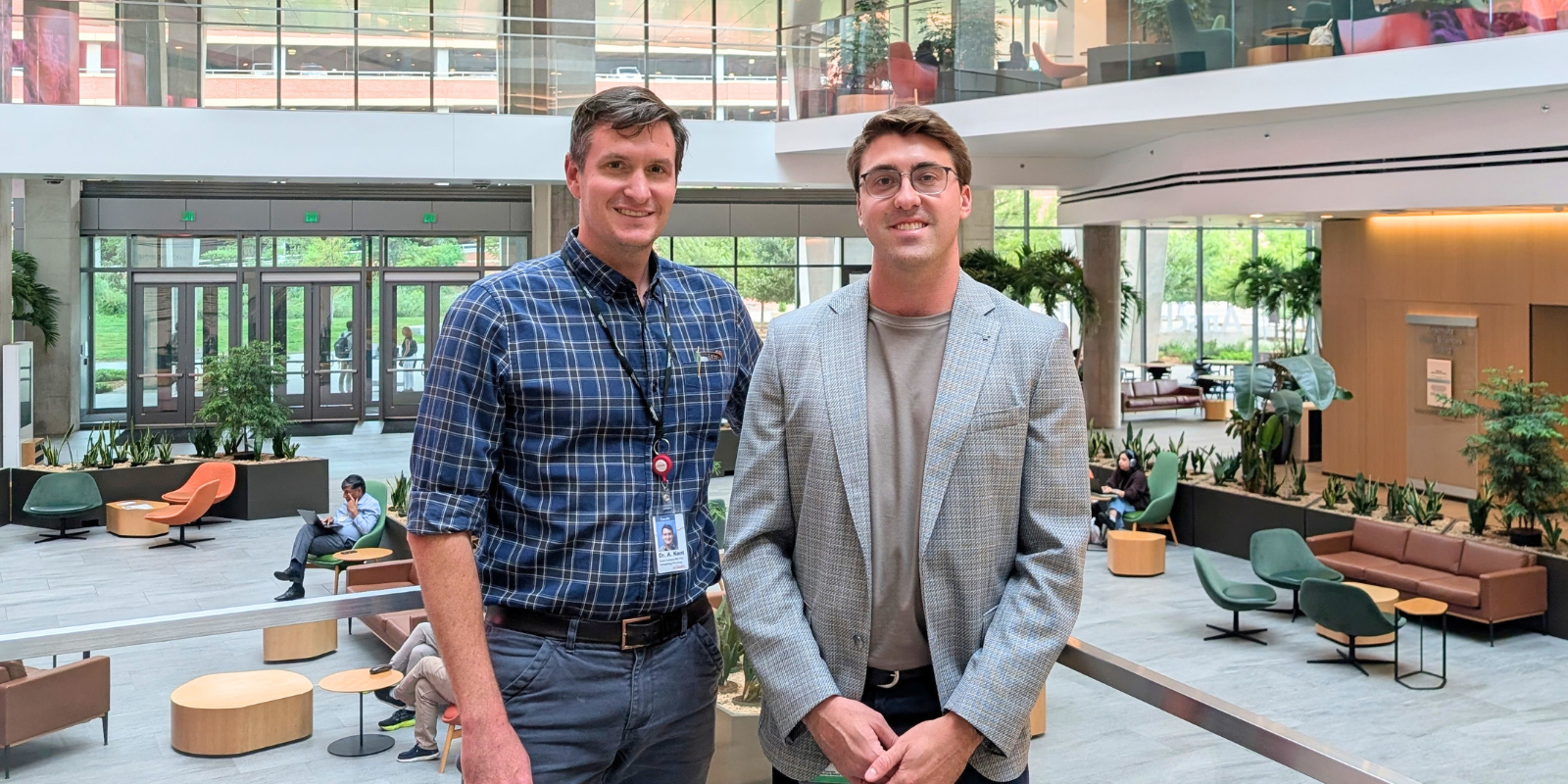
Andrew Kent, MD, PhD, and Ian Shelton, PhD, crossed paths at the University of Colorado Anschutz several years ago when Kent was a fellow and Shelton was a graduate student, both investigating different ways to attack leukemia in different hematology labs.
“Our work and careers have run parallel for a while now,” Kent says.
Kent went on to become a CU Anschutz Cancer Center member and assistant professor in the CU Anschutz Department of Medicine's Division of Hematology. Shelton was recently named director of corporate development and strategy at RefinedScience, a precision-medicine company located in the Fitzsimons Innovation Community complex adjacent to CU Anschutz.
Those parallel paths have brought Kent and Shelton together again. Kent is about to launch a clinical trial of a promising new way to treat advanced, treatment-resistant acute myeloid leukemia (AML). And Shelton’s family, with deep ties to CU, is providing major philanthropic support to that work, fulfilling the wishes of his late grandfather.
Shelton knows that an investigator-initiated trial (IIT) of the sort Kent will lead – one conceived, developed, and run by researchers at CU Anschutz rather than by a pharmaceutical company or other commercial sponsor – can be difficult to finance.
“When I heard more about the science behind this, and knowing where a lot of the advances in the AML space have come from, I understood the power of what they’re trying to do,” Shelton says. “That’s how we decided we would fund a piece of this.”
The support of Shelton’s family “makes this so much more personal and meaningful,” Kent says. “You feel like you're part of a greater community of people who really care about progressing science to help humankind. I feel very fortunate that this university and people involved with this university, like Ian and his family, are dedicated to this. It's the quintessential dream of an academic scientist to work on this kind of project.”
A global leader in AML work
The CU Anschutz Cancer Center has established a global reputation in AML research and treatment. Much of the pioneering work has been done in the hematology labs of cancer center members Dan Pollyea, MD, MS, and Craig Jordan, PhD, alongside specialists in other fields such as Craig Jordan, PhD, whose lab studies cancer development and weaknesses that suggest pathway for new treatments. Kent has frequently collaborated with Pollyea on research, and Shelton worked in Jordan’s lab while seeking his PhD.
AML is an aggressive type of leukemia that accounts for about one in three adult leukemia cases and can spread rapidly to other parts of the body. It starts in the myeloid tissue of the bone marrow. As recently as the 1990s, older patients diagnosed with AML could expect to live just a few months, but research and a string of therapeutic breakthroughs have extended lifespans for many patients.
One of those breakthroughs came a decade ago, when Pollyea, Jordan, and their colleagues were pivotal in establishing the drug venetoclax as a standard-of-care AML therapy. They also have worked to understand how leukemic stem cells help AML resist treatment, and how that resistance can be overcome.
While in Jordan’s lab, Shelton worked on venetoclax resistance in AML patients, studying tumor samples gathered by the lab from donors. He eventually gravitated toward the investment side of research, joining the CU Healthcare Innovation Fund at CU Anschutz Innovations, which makes strategic investments in health care ventures.
Soon, Shelton and others spun off RefinedScience as a joint venture of CU Anschutz and UCHealth. RefinedScience seeks to speed up drug and diagnostic development by combining data from biological samples and clinical records. Pollyea is the company’s chief medical officer.
→ RefinedScience Helps CU Anschutz Researchers Unlock Insights
A two-drug combination
Kent’s new study is for people with advanced AML whose disease has relapsed or never fully responded to previous treatment. A clinical trial will test whether combining two drugs called quizartinib and everolimus will work better than one drug alone.
Quizartinib (brand name Vanflyta) is already approved by the U.S. Food and Drug Administration for AML with a specific mutation called FLT3-ITD, blocking a growth signal that many leukemia cells depend on. But leukemia cells hiding in the bone marrow can activate a different growth pathway, called mTOR, to protect themselves from quizartinib, leading to cancer relapse.
The researchers – drawing on preclinical research by DeGregori’s lab – believe that a treatment schedule combining everolimus, which blocks mTOR, with quizartinib could be more effective over a longer period against AML in patients with or without the FLT3-ITD mutation.
Phase 1 of Kent’s trial will identify the safest effective dose of the two-drug combination. Later phases will test it for effectiveness in separate patient groups with or without the LT3-ITD mutation. Researchers want to know how long patients can avoid relapse under the combined treatment, and how survival rates change.
It’s projected that the study will enroll patients over a three- to five-year period. Treatment will continue as long as it remains effective. Kent expects FDA approval for the trial soon, followed by the start of patient recruitment.
A separate trial Kent is leading is examining whether a different drug, mitoxantrone, can make the standard-of-care drug venetoclax work better as a treatment for certain AML patients. That study is still recruiting patients.
A grandfather’s wish
In 1953, Shelton’s grandfather, Eric Schmidt, came to Colorado from the East Coast to study at CU Boulder. “He always told me that he met my grandma in line for class registration,” Shelton says with a smile. Eric married LaKay Schmidt, and they reared several children, including Shelton’s mother, Debbie.
After graduating, Eric Schmidt stayed engaged with CU as director of industry relations and assistant to the CU president in the 1960s. He served in the Colorado House of Representatives from 1969 to 1973, then was elected to the CU Board of Regents from 1973 to 1979. He later joined what was then the CU Health Sciences Center in central Denver, serving as vice chancellor for external health affairs until 1991. He participated in early discussions that led to the move to what is now CU Anschutz in Aurora.
“He was always very engaged in the medical side of CU, and was interested in the cutting-edge research and excellent level of care that was happening here,” Shelton says. “Everything CU runs very deep in my family.”
Before his death in January 2025, Schmidt talked with his grandson about ways he could financially support medical research at CU Anschutz. “He was looking for the opportunity to give money somewhere that would be impactful to patients in the near term, and he asked me to identify a couple areas on campus that are conducting cutting-edge research,” Shelton says.
Shelton says he considered work by many research groups on campus, “but I especially thought the hematology group is doing excellent work. I started talking with Dan Pollyea about potential trials they were looking at, and that’s when I got connected with Andrew about this opportunity specifically. I brought that information back to my grandpa, and he ultimately decided that this is where he wanted his money to go.”
The best kind of science
Both Kent and Shelton say that IIT trials can be notoriously difficult to finance. “Pharma companies don't necessarily fund things like this,” Shelton says. In this case, Daiichi Sankyo, the company that developed quizartinib, has agreed to supply its drug for the trial.
IIT trials are “not designed for profit at all, except for the patients who potentially get benefit from it,” Kent says. “Because there's no financial gain involved, it's hard to get them started. Without the support of the cancer center and Ian’s family, and luckily Daiichi is involved, it simply wouldn't happen. And without studies like this, founded on science from our labs and the ability to learn from them, we just wouldn’t make the same progress to benefit people that we would otherwise. From beginning to end, this is the best kind of science – science for the benefit of humanity.”
Kent says the team-science spirit and bench-to-bedside ethos at the CU Anschutz Cancer Center and across the campus helps make research like this possible. He also credits the pathfinders in AML research who are now his colleagues.
“Ian and I are younger in our careers,” he says. “There are people who've been on this campus longer who assembled the pieces to enable this kind of project. Our leadership and people like Craig Jordan, Dan Pollyea, and Clay Smith worked hard to create this environment. We really appreciate all the hard work they’ve done.”
“There aren’t many places where scientists in the lab are working so closely with the doctors at the hospital to translate research from bench to bedside,” Shelton says. “I’m really looking forward to seeing how this works out, and we’re hoping this will benefit patients.”
Photo at top: Andrew Kent, MD, PhD, and Ian Shelton, PhD.