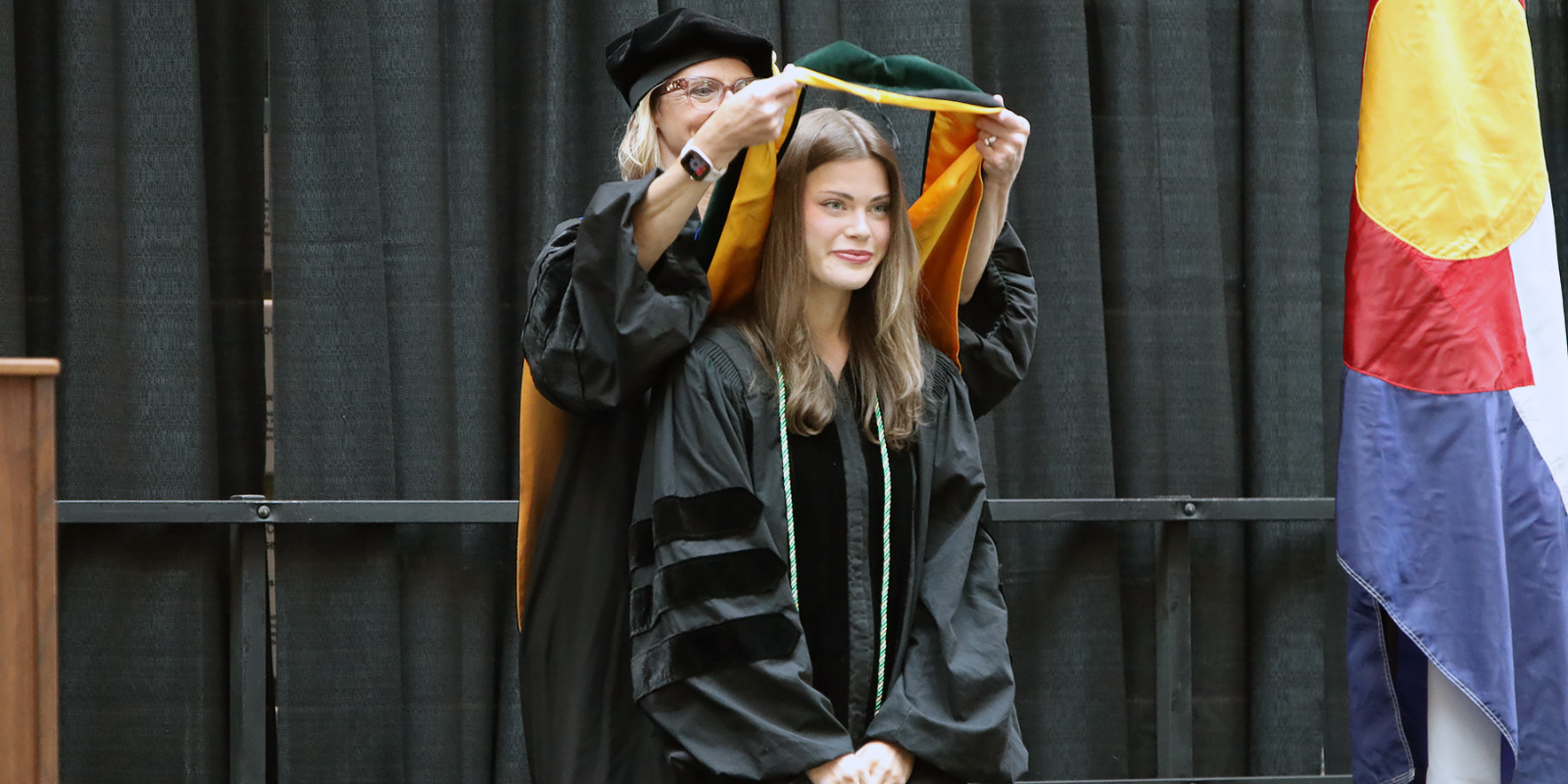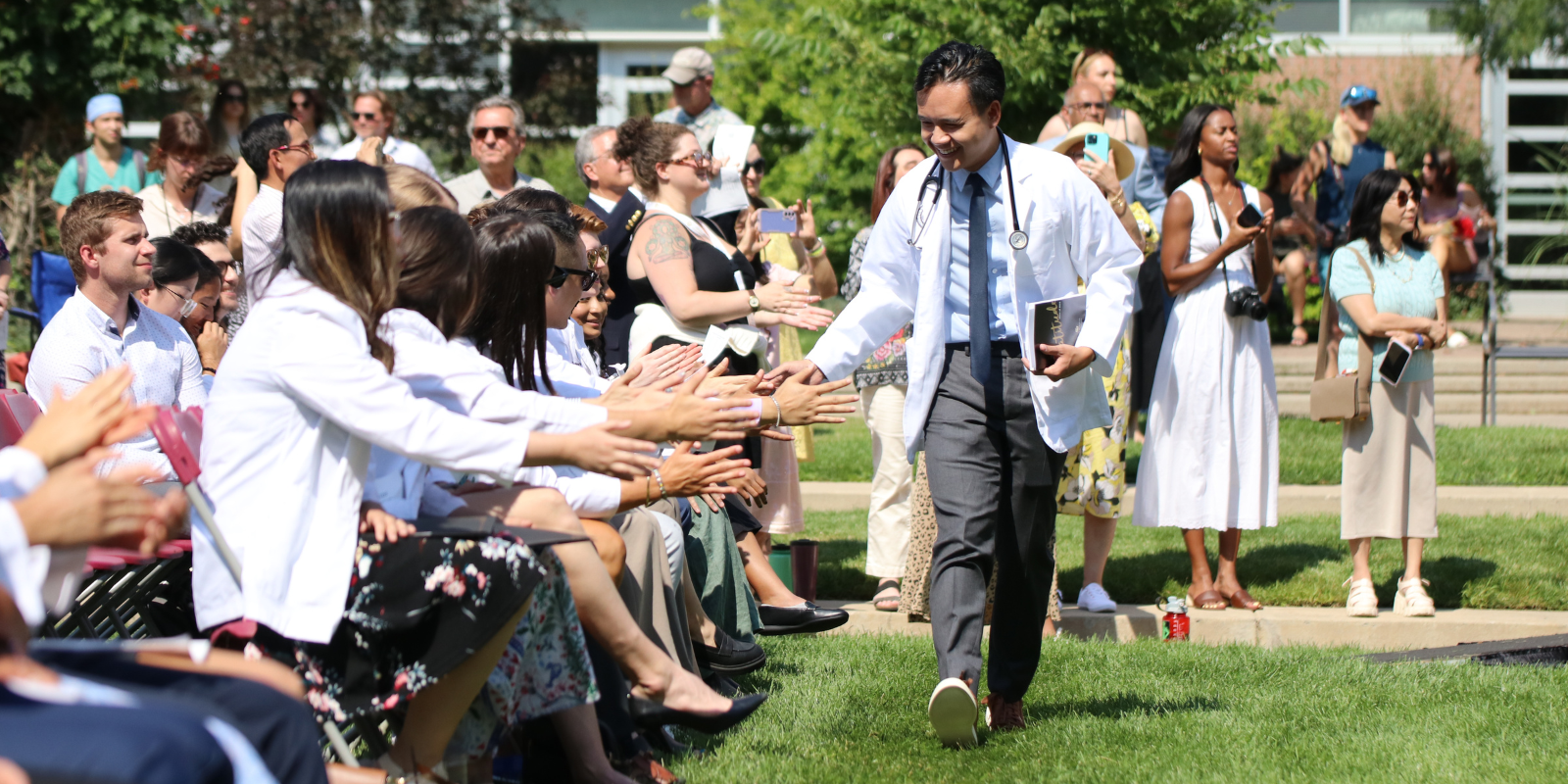
The road to becoming a medical doctor can be long and winding yet exhilarating and rewarding. For the University of Colorado School of Medicine Class of 2029, that journey started Friday, July 25, with a Matriculation Ceremony where students donned their signature white coats for the first time and pledged to their class honor code to uplift colleagues, patients, and communities with compassion and integrity.
The class comprises 184 students, hailing from across the state of Colorado, the country, and the world. 10% of incoming students are first-generation college students and 85% were science majors during their undergraduate education. The class was chosen from a pool of 10,405 applicants and 669 interviews.
→ CU School of Medicine Matriculation 2025: Student Profiles and More
Dean John H. Sampson, MD, PhD, MHSc, MBA, welcomed the students to the next chapter of their education.
“You have distinguished yourselves in your academics, in your community service, and in your many commitments. It’s also clear that you are distinguished in another important way,” Sampson said in his opening remarks. “You have exceptional support from your family, friends, loved ones, teachers, and mentors. Looking at the crowd of supporters behind you today, you have strong networks, and we join them in cheering you on. You have earned being here.”
Becoming the ‘total package’
The students will now spend the next four years honing new skills, mastering fundamentals, and following their passion for medicine.
“When you graduate, we want you to be the total package,” Sampson said, highlighting that students will be “trained in tradition, prepared through excellence, compassionate in their caring, curious in their questions, and continuous in their improvement.”
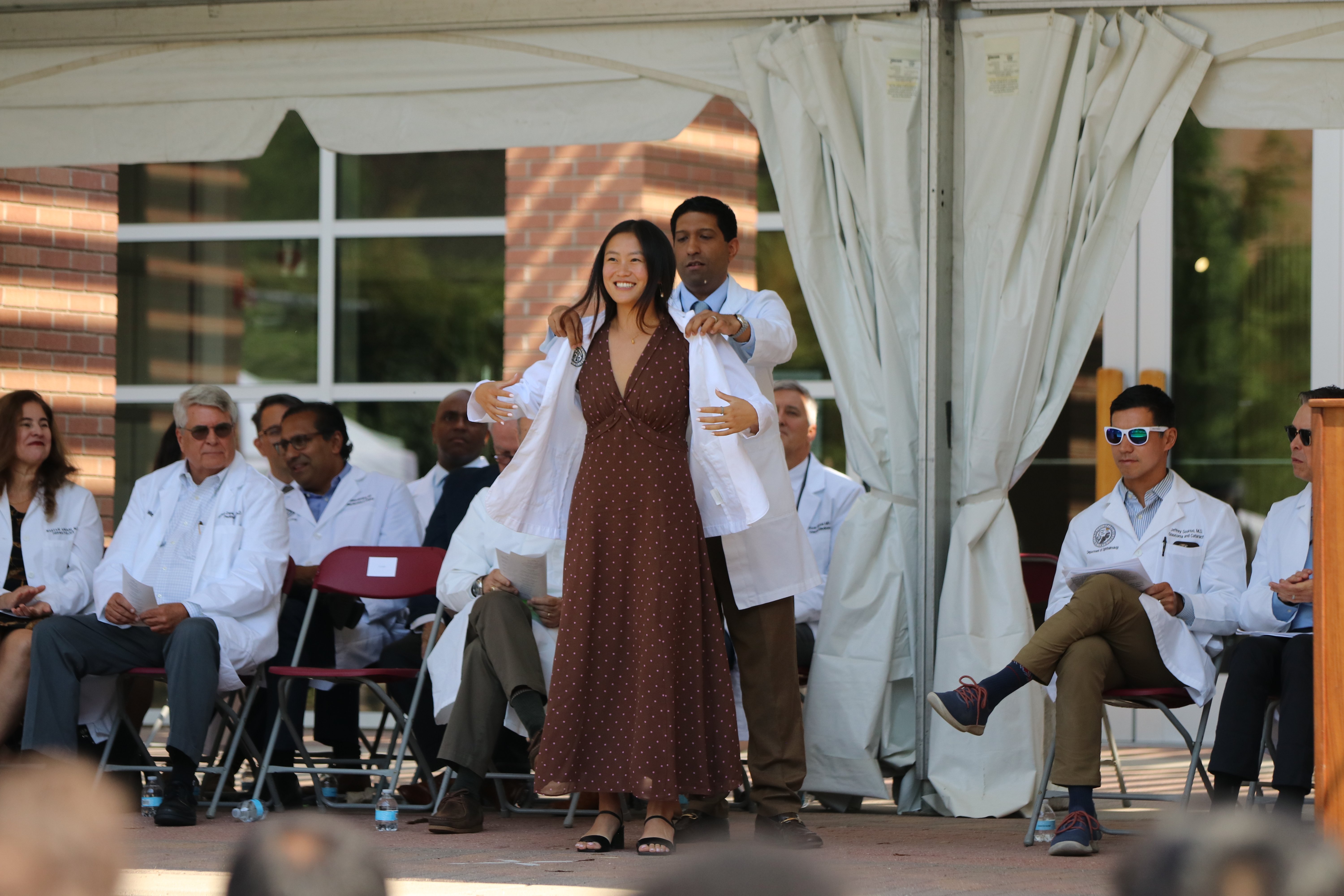 A student receives their first white coat, a rite of passage into the field of medicine, at the CU School of Medicine's Class of 2029 Matriculation Ceremony.
“Our commitment to guide you through this process is a recognition that our work is more than a job, it’s a calling to serve,” Sampson continued.
For some, like incoming student Cameron Meikle, that calling originated at home. In a student profile showcasing the incoming class, Meikle said he’s on the path to becoming a physician thanks to frequent at-home science experiments created by his dad, an ecologist.
Class of 2029 students Trinity Brigham and Brooke Linden both said they were pulled toward medicine when cancer and other health conditions affected their family members.
“My granny was diagnosed with Alzheimer’s disease around the time I was born, so I never really got to know her,” Brigham said. “Then, in high school, my aunt got lung cancer. She never smoked a day in her life. From there, my interest really started to grow because I was curious about so many aspects of these diseases and why certain diseases impact some people and not others.”
For others, that calling has developed over time. Jaydep Halder said a series of small glimmers kept guiding him toward a unique path in medicine, carved by his desire to combine policy and health care.
‘Listen with care’
Following school tradition, each incoming medical student received a Littman 4 Cardiology stethoscope, a gift from CU School of Medicine alumni, to go along with their new white coats.
“The gift of a stethoscope is practical but also filled with meaning. A stethoscope allows you to listen carefully,” Sampson said. “Sometimes listening is the most important part of doctoring. When you carry your stethoscope with you, I hope it’s a reminder for you to listen with care.”
That advice may holder truer now than ever.
“Our goal is to send a message that in your career you need to realize that a truly competent physician is the one who balances excellence in science and clinical skills with compassionate patient care for all individuals in our communities,” said Brian Dwinnell, MD, FACP, associate dean for student life. “Has there ever been a time in which emphasizing this was more important?”

A new student receives their first stethoscope as part of the Matriculation Ceremony.
In addition to the symbolic bond the stethoscopes offer between physicians and their patients, Mark Gonçalves, MD ’82 and president of the CU Medical Alumni Association, said the instrument represents the bond students will make with each other and other physicians.
“I think you will find that among your strongest support systems through these challenges will be your classmates and colleagues, many of whom become long-term, even lifelong, friends, because they are sharing the same challenges with you,” he said.
Incoming students also received a gratitude journal from the Gold Humanism Honor Society, which inducted 31 new members during the ceremony, as a reminder to reflect on wellness and growth, completing a triad of gifts that aim to carry students through schooling and into their professional lives.
The journey ahead
In his keynote, Alkesh Jani, MD, professor of medicine and the Renal Section Chief at the Rocky Mountain Regional Veterans Administration Medical Center, encouraged students to relish the moment, for the real challenge begins with the start of classes.
→ VIDEO: Watch the 2025 CU School of Medicine Matriculation Ceremony
Jani offered up his own gift to the Class of 2029: A set of learning objectives, including remembering to have fun, making time to rest, exercising patience, and listening to those “spidey senses.”
“I cannot tell you how many times it has saved me and my colleagues,” he said. “Sometimes, your spidey sense will be quite subtle, a vague feeling of unease, almost like when you suddenly realize you don’t know where your keys are. When that happens, don’t ignore it, just think back on all the things you’ve done recently. If you’ve made a diagnosis but you felt uneasy, go back and see the patient again. It never hurts to double check things.”
Meeting the moment
To conclude the White Coat Ceremony, Shanta Zimmer, MD, executive vice dean of education, recited the Class of 2029 Honor Code, which will be displayed in a campus lecture hall.
It encourages students to recognize their roles as healers and serves as a reminder that their duties often extend beyond the walls of a hospital.
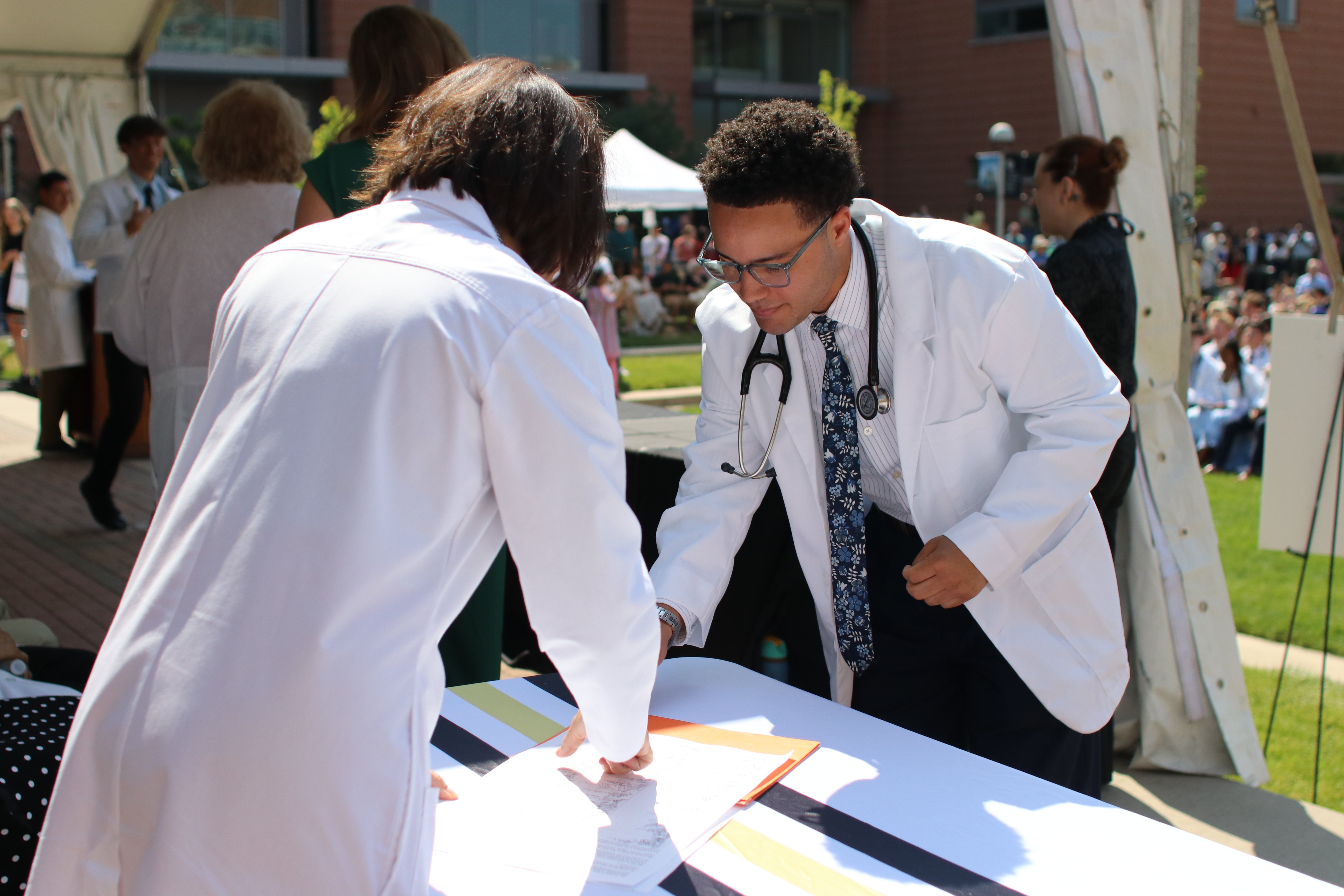
An incoming student signs their name to the Class of 2029 Honor Code after receiving their white coat and stethoscope.
“We will be aware of our social and political environment, and we will defend against injustices that jeopardize the well-being of our communities,” the code reads in part. “We recognize, as have leaders before us, that a threat to justice anywhere is a threat to justice everywhere. It is our responsibility to advocate for the world in which we wish to live and practice.”
Sampson underlined those sentiments in his own words during his remarks.
“These skills give meaning to our work and recognize the dignity of each person we care for regardless of their background,” he said. “In our clinics and in hospital wards, we encounter people of all races, beliefs, and financial circumstances…In a world that often feels like we are divided from one another, we bring people together for a noble purpose: to care for one another.”
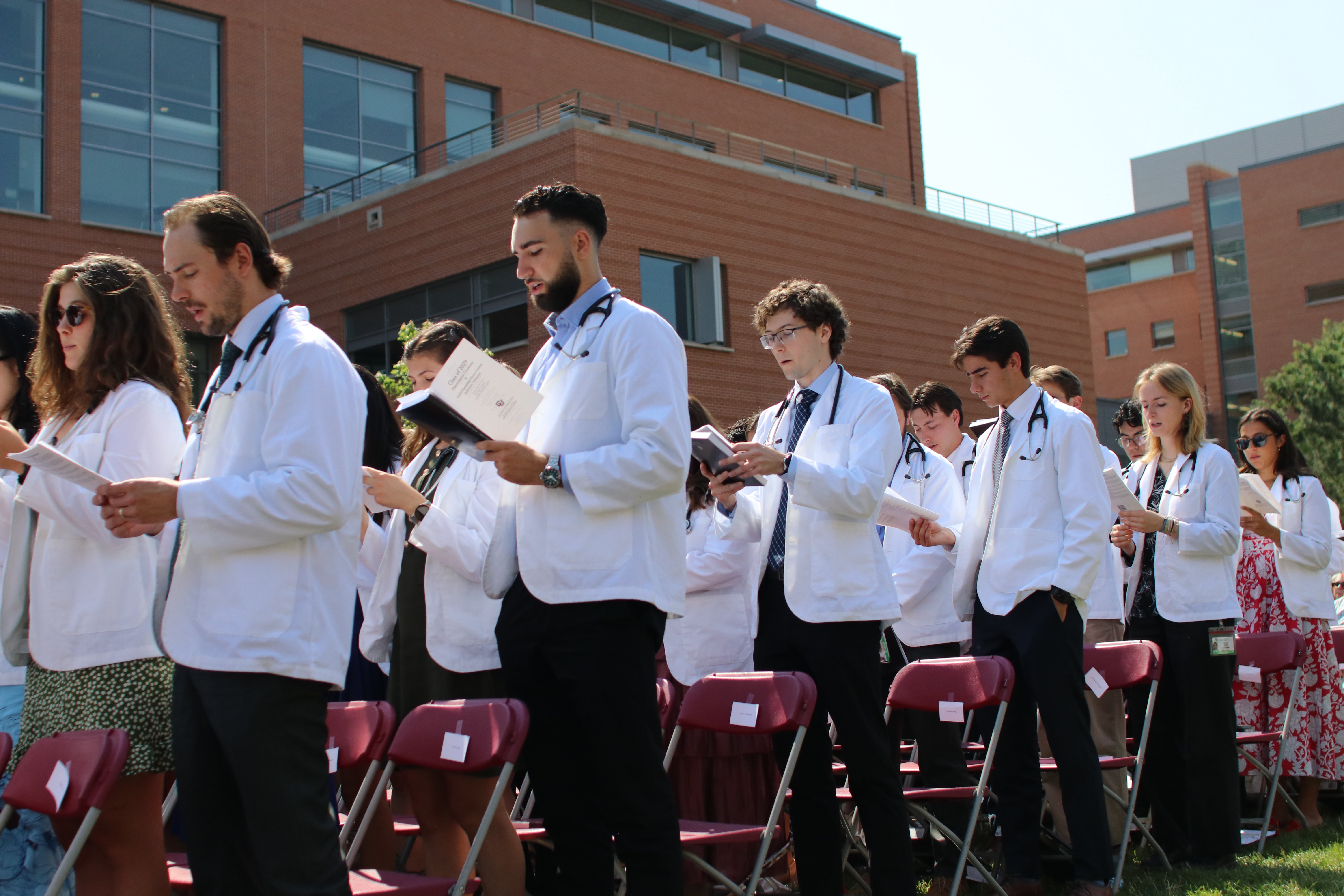
Incoming students from the Class of 2029 read along as a faculty member recites the class Honor Code, which will be displayed in a lecture hall.
The Class of 2029 Honor Code:
“We, the class of 2029, are committed to uplifting our colleagues, patients, and communities with compassion and integrity. We will find strength in our commonalities, build bridges between our differences, and respect unique perspectives. Bolstered by our diversity, we will strive to care for our patients while acknowledging that health transcends the individual.
We recognize our roles as healers extend beyond the walls of the hospital, and we commit to providing stability to our peers and patients during times of uncertainty. As current and lifelong learners, we devote ourselves to practicing evidence-based medicine and challenging misinformation through research and education.
We will be aware of our social and political environment, and we will defend against injustices that jeopardize the well-being of our communities. We recognize, as have leaders before us, that a threat to justice anywhere is a threat to justice everywhere. It is our responsibility to advocate for the world in which we wish to live and practice. We will learn from our patients in reciprocity and never let our position disconnect us from our humanity. We embrace the mantles of service, inclusion, advocacy, and empathy.
We promise to invest in each other as our collective success is dependent on that of the individual. We hold our class to the highest standards of mutual respect, honesty, integrity, and humility.
We are confident in our ability to positively impact our communities and each other. We promise never to take for granted the title of physician. We vow to uphold this honor statement throughout our education and careers in pursuit of a brighter future for medicine.”
.png)