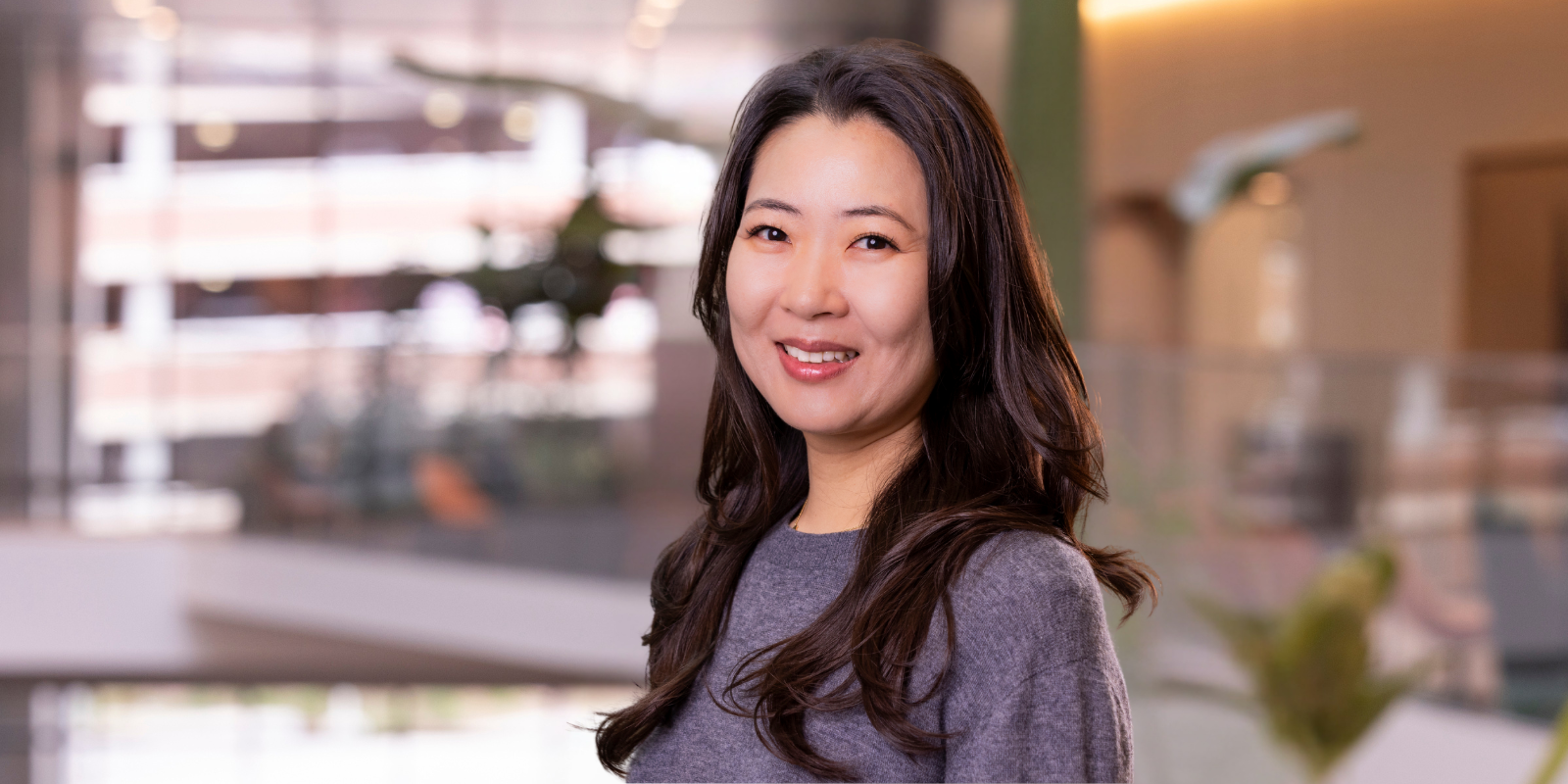
In recognition of her innovative research to advance eye health care, Mi-Hyun Nam, PhD, an assistant professor in the University of Colorado Department of Ophthalmology, received the 2025 Philip and Elaine Ellis New Investigator in Ophthalmology Research Award.
The award grants $40,000 to an early-career researcher at the Sue Anschutz-Rodgers Eye Center who displays exceptional potential, aiming to bolster their work. The fund was created in 2020 by Philip Ellis, MD, who served as the department chair from 1960 to 1995, and his late wife, Elaine Ellis.
“Dr. Nam’s groundbreaking research, dedication to excellence, and lasting contributions to the field make her highly deserving of this recognition,” says Ram Nagaraj, PhD, a professor of ophthalmology and mentor to Nam.
Joe Brzezinski, PhD, the department’s research director and an associate professor of ophthalmology, agrees, which is why he nominated Nam for the award.
“Dr. Nam, or ‘Nammi’ to her colleagues, is an exceptionally resourceful and hard-working scientist,” Brzezinski says. “Nammi is advancing several different projects to help preserve the neurons in the retina to slow and potentially reverse vision loss that occurs in serious diseases, like glaucoma.”
Glaucoma is a group of eye diseases that damage a person’s optic nerve, often because there is too much pressure in the eye. It is one of the leading causes of irreversible blindness in the United States, and it affects more than 3 million Americans, according to the U.S. Centers for Disease Control and Prevention.
“Glaucoma is very complicated, and there is no way to reverse this disease. That’s why I’m doing this work,” Nam says. “When I found out I got this award, I couldn’t believe it. Research, for me, feels like a marathon. This is like getting new fuel so I can move faster, and it assures me that I’m running in the right direction.”
A mission to save vision
After receiving her PhD from Korea University in the spring of 2016, Nam’s PhD mentor recommended that Nam go to the CU Anschutz Medical Campus and join Nagaraj’s lab. Nam, who was born and raised in South Korea and had never visited Colorado before, joined CU that October as a postdoctoral fellow, working with Nagaraj for over five years before becoming a faculty member in 2022.
“His vision and enthusiasm for the research inspired me a lot,” Nam says. “In his lab, I began working more on the retina, which was so fascinating to me because of how dynamic it is. That motivated me to stay at CU to work on retinal degenerative diseases like glaucoma.”
Much of Nam’s work has centered around a specific type of neuron in the eye called retinal ganglion cells, which are the only cell type that connect the retina and brain. They transport all the visual information to the brain, including image formation, movement, contrast, and color.
“This cell has a cell body with a long axon that connects to the brain, like a long cable. If this cable is disconnected, then a person will be unable to see. That’s why these cells are so important,” she says.
The axons of retinal ganglion cells combine together to form the optic nerve. If a person has glaucoma, typically these axons will degenerate over time — a big problem, because once these cells are degenerated, they cannot be restored.
“My goal is to fix the cable, or reconnect that access, so we can hopefully restore the vision loss,” she says. “I’ve heard from a pediatric clinician that she feels awful when she comes across young glaucoma patients, because we expect that the patient will lose their vision in the next 10 to 20 years. It makes me want to work harder in this field to help these patients, increase their quality of life, and save their vision.”
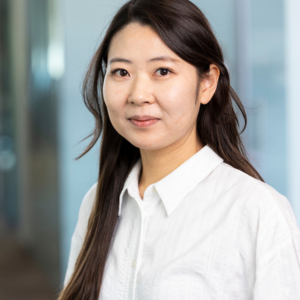
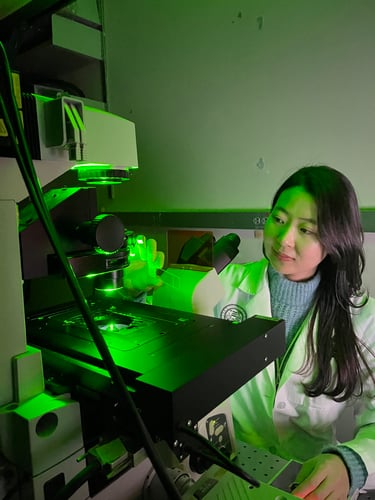 Mi-Hyun Nam, PhD, is an assistant professor in the CU Department of Ophthalmology. Image courtesy of Nam.
Protecting cells from damage
One of Nam’s proudest accomplishments in her career so far has been the work she did with Nagaraj to develop several neuroprotective strategies to “rescue the retinal ganglion cells,” she explains.
In one study that Nam helped lead, she and Nagaraj found that a certain kind of peptide called peptains were able to block some damage to retinal ganglion cells in animal models of glaucoma. As a result, the investigators proposed that peptains have the potential to be developed as therapeutics against neurodegenerative diseases such as glaucoma and dry age-related macular degeneration.
In another study, Nam and Nagaraj developed a gene therapy that helped prevent the death of retinal ganglion cells in an animal model of ocular hypertension. The findings suggest that a single injection of this gene therapy could be enough to prevent vision loss on a long-term basis, the researchers concluded.
“Dr. Nam is an innovative and committed scientist whose leadership and teamwork motivate colleagues and students,” Nagaraj says. “Her work has provided new insights into neuroprotection in glaucoma, enhancing scientific knowledge and practical applications.”
Exploring ways to restore vision
In her current work, Nam is collaborating with Natalia Vergara, PhD, assistant professor of ophthalmology, to develop stem cell therapy for transplanting retinal ganglion cells and explore whether it can restore vision in glaucoma.
Vergara is among the leaders conducting pivotal work in the CU Department of Ophthalmology’s ocular stem cell and regeneration research program called CellSight. Vergara is the director of CellSight’s Ocular Development and Translational Technologies Laboratory, and she conducts research that uses retinal organoids. These organoids are similar to human retinas, but they are artificially created in a lab from induced pluripotent stem cells.
“We are trying to replace an animal model’s retinal cells and replenish it with new stem cell-derived retinal ganglion cells. We transduced these cells to enhance their resilience, and we’ve seen very promising data. After engineering, the cells survive longer and integrate better,” Nam says. “Our goal is to identify which subtypes of retinal ganglion cells are being transplanted into the eyes, given the diversity of these cells.”
Nam plans to use the funds from the Philip and Elaine Ellis New Investigator in Ophthalmology Research Award to help her characterize the subtypes of retinal ganglion cells and determine whether these transplanted cells are more resilient against glaucoma.
“This work may require spatial RNA sequencing, and this award will help me use new technology to conduct this research,” she says.
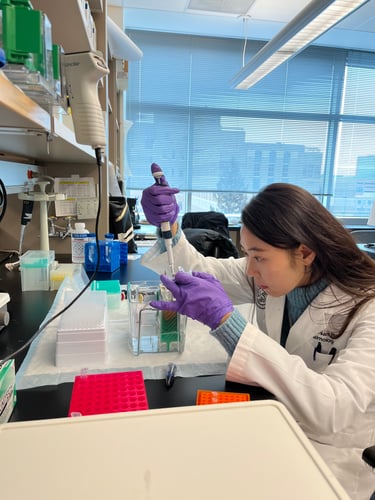 Mi-Hyun Nam, PhD, working in a research lab. Image provided by Nam.
‘A rising star’
Nam’s long-term goal is to restore some level of vision in patients with advanced glaucoma who have lost their ability to see.
“It would be really difficult to fully restore a person’s vision, but what if a totally blind person could begin to perceive light or detect motion? Even that much improvement would be meaningful to patients,” she says.
In the meantime, Nam will continue running her research marathon, taking one step at a time toward improving outcomes for the millions of people with glaucoma. Although she views herself as only being a few miles into the marathon, her mentors know she’s on a path toward success.
“Nammi is a rising star,” says Brzezinski, director of CellSight’s Laboratory of Developmental Genetics. “Her skills, dedication, and teamwork position her to make big impacts on vision research in the near future.”