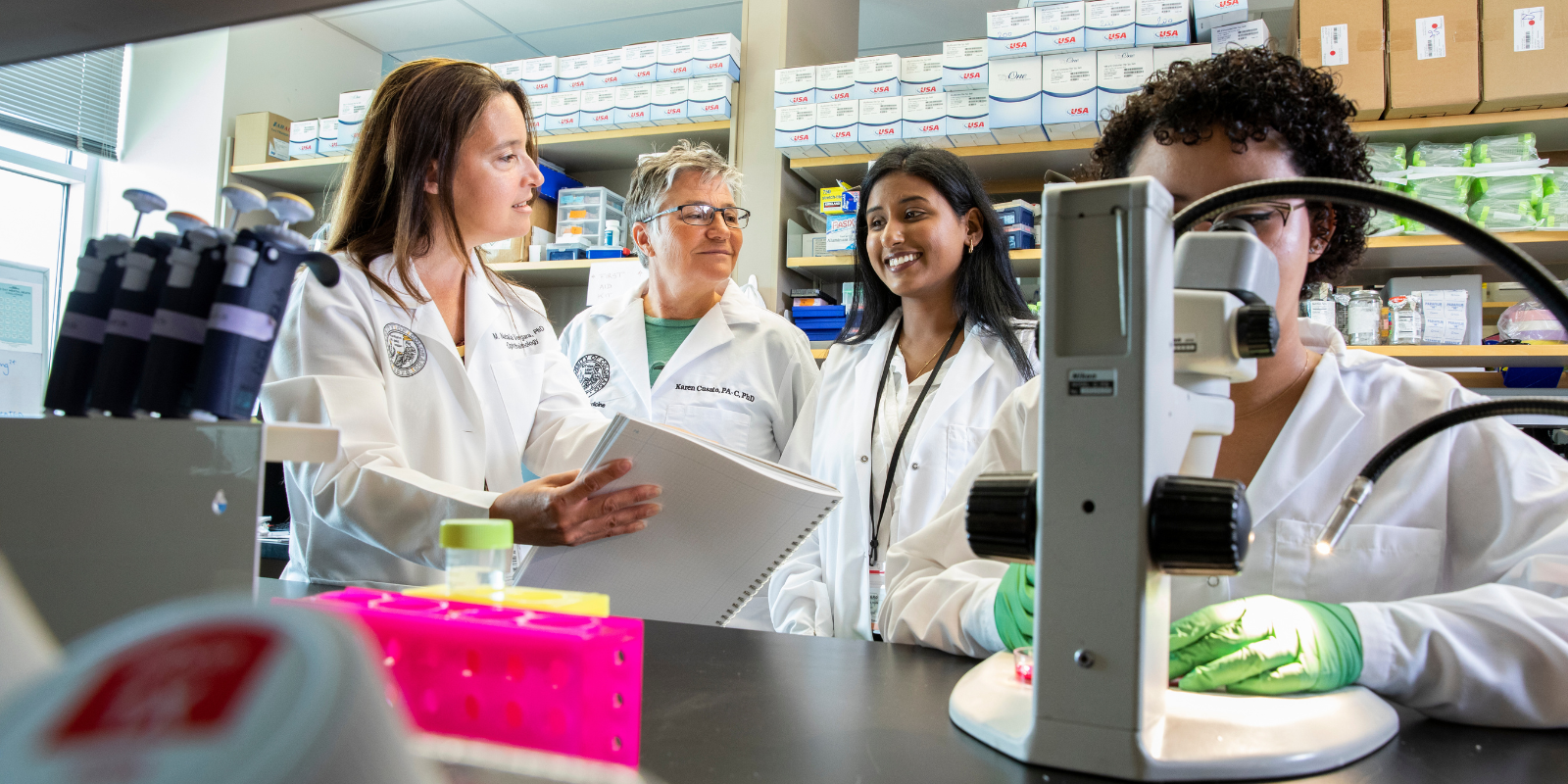
Thirteen multidisciplinary research teams with innovative projects to advance vision science have been awarded seed grants by the University of Colorado Anschutz Department of Ophthalmology’s Vision Science Research and Translation Accelerator (VISTA) Program.
Seed grants support early-stage research projects, helping researchers build evidence to compete for larger, competitive state and federal grants. Each of these VISTA grants, amounting to nearly $1.5 million in total funding, will support a team led by one of 13 principal investigators who represent seven different departments and divisions across the CU Anschutz campus. These teams include an additional 25 unique co-investigators, spanning a total of 10 departments and divisions.
The VISTA Program came to fruition through the ideation of Department Chair Naresh Mandava, MD, who tasked Joe Brzezinski, PhD, the department’s director of research, and ophthalmology professors Tianjing Li, MD, PhD, and Alan Palestine, MD, with establishing an impactful seed grant initiative. The program is supported in part by the historic $40 million gift the department received in 2025.
“I am grateful to our ophthalmology research leaders for taking the time to review so many terrific vision science proposals spanning the entire campus. This is an important step to leverage the amazing talent across CU Anschutz,” says Mandava.
“The Sue Anschutz-Rodgers Eye Center created this program to build a strong community of multidisciplinary teams that tackle vision science problems to discover ways to understand, detect, predict, and treat eye diseases,” Brzezinski adds. “One of the things I’m really excited about is how diverse the portfolio is. It’s bringing many different experts together to work on projects that span the research pipeline — including fundamental mechanism, translational, and clinical studies.”
The 13 award-winning CU Anschutz projects and their respective principal investigators are:
- Alison Abraham, PhD, MS, MHS, a professor and vice chair of education in epidemiology at the Colorado School of Public Health with a secondary appointment in ophthalmology, is leading the project: “Perceptions of vision care quality and access improvement with a mobile care eye service in aging adult communities.”
- Gidon Felsen, PhD, professor and co-director of the neuroscience program in the Department of Physiology and Biophysics with a secondary appointment in ophthalmology, is leading the project: “How saccades modulate visual representations.”
- Talisa Forest (de Carlo), MD, assistant professor and medical director of imaging in the ophthalmology department, is leading the project: “Toward a novel strategy to prevent subretinal fibrosis in neovascular age-related macular degeneration.”
- Jay Hesselberth, PhD, professor of biochemistry and molecular genetics and co-director of the RNA Bioscience Initiative, is leading the project: “A mutation-agnostic therapeutic approach to correct cryptic splicing in inherited retinal diseases.”
- Alison Liu, MD, PhD, MPH, assistant research professor of ophthalmology with a secondary appointment in epidemiology, is leading the project: “Factors associated with changes in symptoms or signs of dry eye over time: A pilot cohort study.”
- James Maloney, MD, professor of pulmonary, allergy, and critical care medicine and medical director of the pulmonary ward at the UCHealth University of Colorado Hospital, is leading the project: “Topical NSP15 as a novel drug to heal corneal ulcers.”
- Mi-Hyun Nam, PhD, assistant professor of ophthalmology, is leading the project: “Advancing a promising cell therapy to reverse blindness in glaucoma.”
- Ruth Napier, PhD, associate professor of rheumatology with a secondary appointment in ophthalmology, is leading the project: “Genetic underpinnings of juvenile idiopathic arthritis-associated uveitis endotypes.”
- Paul Norman, PhD, professor of biomedical informatics, is leading the project: “The role of killer cell receptor diversity in birdshot chorioretinopathy.”
- Mina Pantcheva, MD, associate professor of ophthalmology, is leading the project: “Home-based intraocular pressure monitoring after subtenon triamcinolone acetonide injections in patients with uveitis.”
- Riaz Qureshi, PhD, MS, assistant professor of ophthalmology with a secondary appointment in epidemiology, is leading the project: “A mixed-methods study of barriers and facilitators to vision care in long-term care facilities.”
- Amit Reddy, MD, assistant professor of ophthalmology, is leading the project: “Identifying gut microbiome signatures in HLA-B27-associated uveitis: A longitudinal pilot study.”
- Natalia Vergara, PhD, assistant professor of ophthalmology, is leading the project: “Long-acting photoreceptor-protective therapy for dry age-related macular degeneration.”
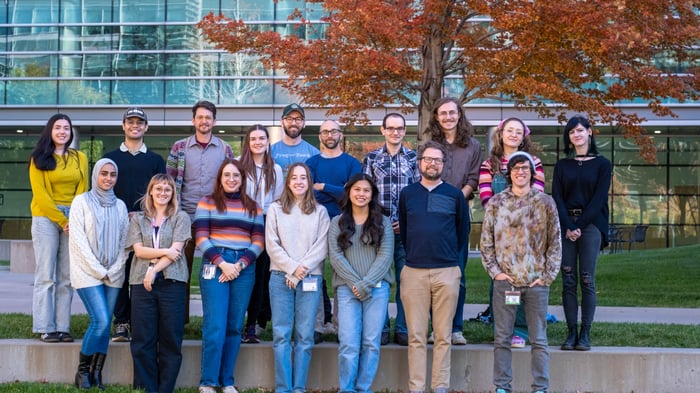 Gidon Felsen, PhD, pictured second from the right in the first row, smiles alongside researchers in the Vision Cluster. His VISTA project is a collaborative initiative among a few labs in the Vision Cluster. Image courtesy of Felsen.
‘Thrilled, honored, and grateful’
As neuroscientists interested in better understanding the visual system, Felsen and his colleagues Alon Poleg-Polsky, MD, PhD, and Benjamin Scholl, PhD, applied to the VISTA Program to advance their collaborative research. When they found out they would receive a VISTA award, Felsen says they were “thrilled, honored, and grateful.”
“Researchers constantly grapple with the problem that you need funding to perform research, but you need to show results to obtain funding in the first place,” he says. “Support from the VISTA Program solves this chicken-and-egg problem by providing seed funding to get the project started, which will not only allow us to begin to address our scientific questions, but will also make us more competitive for obtaining more substantial support in the near future, increasing the impact of our research on fundamental knowledge and clinical practice.”
Their project — which is a collaboration among each of their three labs and is supported by the CU Anschutz Department of Physiology and Biophysics Chair David DiGregorio, PhD — focuses on the question: How do people maintain a stable visual percept despite the fact that they are constantly moving their head and eyes?
Within the framework of active vision, Felsen and his colleagues are interested in understanding how the brain disambiguates the visual signals arising from external motion versus self-generated motion.
“Addressing these questions will ultimately lead to better patient outcomes in several ways. For example, a major shortcoming of prostheses for restoring vision is that they do not yet take self-motion into account when representing the visual world. Our research forms the basis for self-motion-correcting visual prostheses,” Felsen says.
“Second, more generally, the ability to account for self-motion is a fundamental function of the visual system under normal conditions,” he adds. “Understanding how vision works normally is a critical step for identifying treatments for visual dysfunction. While the path from bench to bedside can be long, basic research is the engine that drives clinical practice forward.”
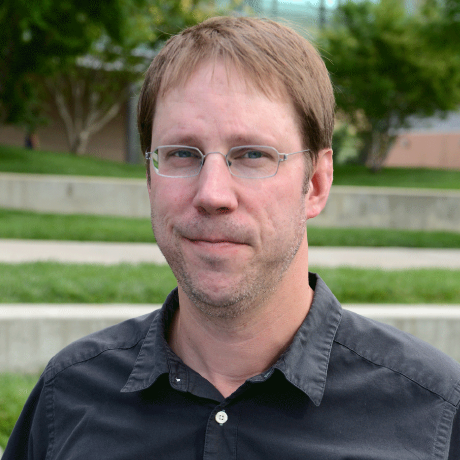 Jay Hesselberth, PhD, is a professor of biochemistry and molecular genetics and co-director of the RNA Bioscience Initiative.
Developing therapies for ‘devastating diseases’
As co-director of the RNA Bioscience Initiative at the CU Anschutz School of Medicine, much of Hesselberth’s research focuses on RNA damage and repair. He and his colleagues were already working toward applications of an RNA therapy in genetic ocular disease when he learned of the opportunity to apply for a VISTA award.
“It is always gratifying to receive external recognition of your ideas, and we are excited to get started on this work,” Hesselberth says. “The support will help us move our broader ideas in a specific direction — application to inherited retinal diseases.”
Inherited retinal diseases are a group of rare genetic eye conditions that affect the retina — the layer inside the eye that detects light and transmits key visual information to the brain — and can cause progressive vision loss.
“We are developing RNA therapies to correct messenger RNA misprocessing (mRNA) in inherited retinal diseases,” Hesselberth says. “Our major goals are to understand how common inherited retinal diseases impact mRNA processing, and to use this information to design new RNA therapies.”
To conduct this work, Hesselberth is collaborating with Sujatha Jagannathan, PhD, an assistant professor of biochemistry and molecular genetics who runs her own lab at the RNA Bioscience Initiative, and his co-investigator Emily McCourt, MD, chief of pediatric ophthalmology at the Sue Anschutz-Rodgers Eye Center and Children’s Hospital Colorado. McCourt has already developed RNA therapies approved by the Food and Drug Administration (FDA) for ocular disease.
“We are hoping to repeat this success,” he says, noting that their research team also includes RNA biologists, retinal developmental biologists, and ophthalmologists. “We are hoping to connect fundamental molecular concepts to real-world therapies for devastating diseases, and each piece of the team will be critical for success.”
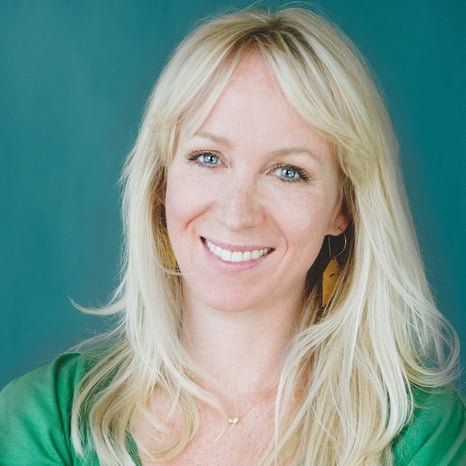 Ruth Napier, PhD, is an associate professor of rheumatology with a secondary appointment in ophthalmology at CU Anschutz.
Advancing care for children with arthritis
Support from the VISTA Program will allow Napier to collaborate with ophthalmology and rheumatology specialists at Children’s Hospital Colorado and UCHealth to investigate a condition where some children with arthritis develop uveitis — a broad term for a type of eye inflammation that can lead to vision problems and permanent blindness.
Although many of these children are given the same diagnosis of juvenile idiopathic arthritis with uveitis, their disease behaves differently, Napier explains. Some respond well to standard medications, while others continue to have eye damage despite treatment.
“Right now, doctors cannot predict which children are at highest risk or which medicine will work best for an individual child,” she says. “The ultimate goal is to move away from trial-and-error treatment and toward precision medicine, where therapy is chosen based on a child’s underlying biology.”
Napier and her research team plan to focus on a specific gene called NOD2. Rare mutations in this gene cause Blau syndrome, a disease that includes arthritis, eye inflammation, and skin rash, she explains.
“New evidence shows that some children diagnosed with ‘regular’ juvenile arthritis may actually carry Blau-like NOD2 mutations, even though they were never recognized as such. Our research team believes that children with these NOD2 mutations have a specific type of immune response that drives inflammation in the eye,” she says. “Importantly, drugs that target this type of immune response already exist and are FDA-approved for other diseases.”
Napier’s team aims to test children and adults with arthritis-related uveitis to see how common NOD2 mutations are, measure immune signals in their blood to see who has the predicted immune response, and connect genetics, immune behavior, and real clinical outcomes.
“Being selected as one of only 13 awardees is incredibly humbling,” she says, adding that her team feels “a strong sense of responsibility to translate this opportunity into meaningful impact for patients.”
“By fostering these cross-disciplinary and cross-institutional collaborations, the VISTA Program is helping to establish a durable research network that we anticipate will extend well beyond the scope of this project and position the team for sustained collaboration and future National Institutes of Health (NIH) funding,” she adds.
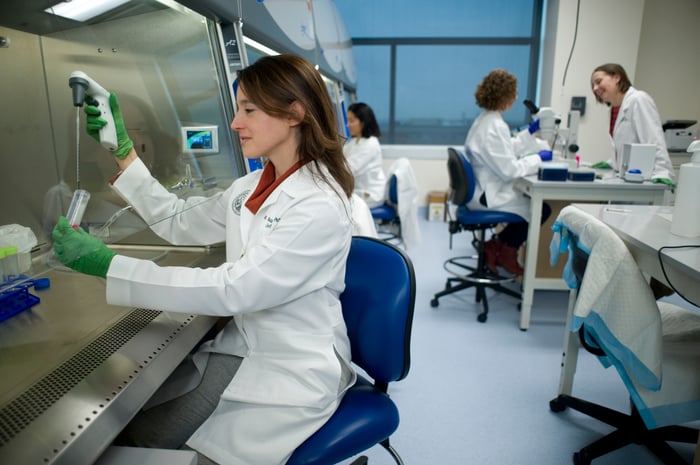 Natalia Vergara, PhD, working on research in a lab.
Developing long-lasting treatments to protect vision
Vergara, director of the Ocular Development and Translational Technologies Laboratory in the CellSight Program, is working closely with vision scientists like Mi-Hyun Nam, PhD, Daewon Park, PhD, and Ram Nagaraj, PhD, to preserve vision by protecting photoreceptors, the light-sensing cells of the eye.
“In retinal diseases like dry age-related macular degeneration (AMD), these cells slowly die, and once they’re gone, vision loss is permanent,” Vergara says.
Her team has developed a small, protective molecule — a peptide — that shields photoreceptors in stressful conditions that normally cause them to degenerate, she explains.
“The VISTA seed grant will support the next critical step: packaging this protective peptide into biodegradable nanoparticles that allow it to be released slowly inside the eye over time,” she says. “In simple terms, we’re trying to turn a powerful but short-acting therapy into a long-lasting treatment that could realistically be used in patients.”
This work is built on results obtained using a combination of animal models with human-relevant research models, including stem cell-derived retinal tissues, she explains. This allows the team to study potential therapies in a way that more closely reflects what happens in patients, increasing the likelihood that successful lab findings will translate into real treatments.
By directly protecting photoreceptors, Vergara says this therapy has the potential to help people maintain usable vision for longer as well as lessen the burden of ongoing treatments.
The VISTA award comes at a pivotal moment, she notes. The funding will allow her team to carry out critical studies focused on optimizing the delivery platform, rigorously testing safety and efficacy, and generating the data required to pursue future NIH funding.
“Vision loss is a complex problem, and solving it requires expertise that spans biology, engineering, medicine, and more. The VISTA Program encourages and enables those connections,” Vergara says. “By supporting multidisciplinary teams and early-stage translational work, this program helps ensure that discoveries move beyond the lab, building a pipeline for innovation that can increase patient impact.”