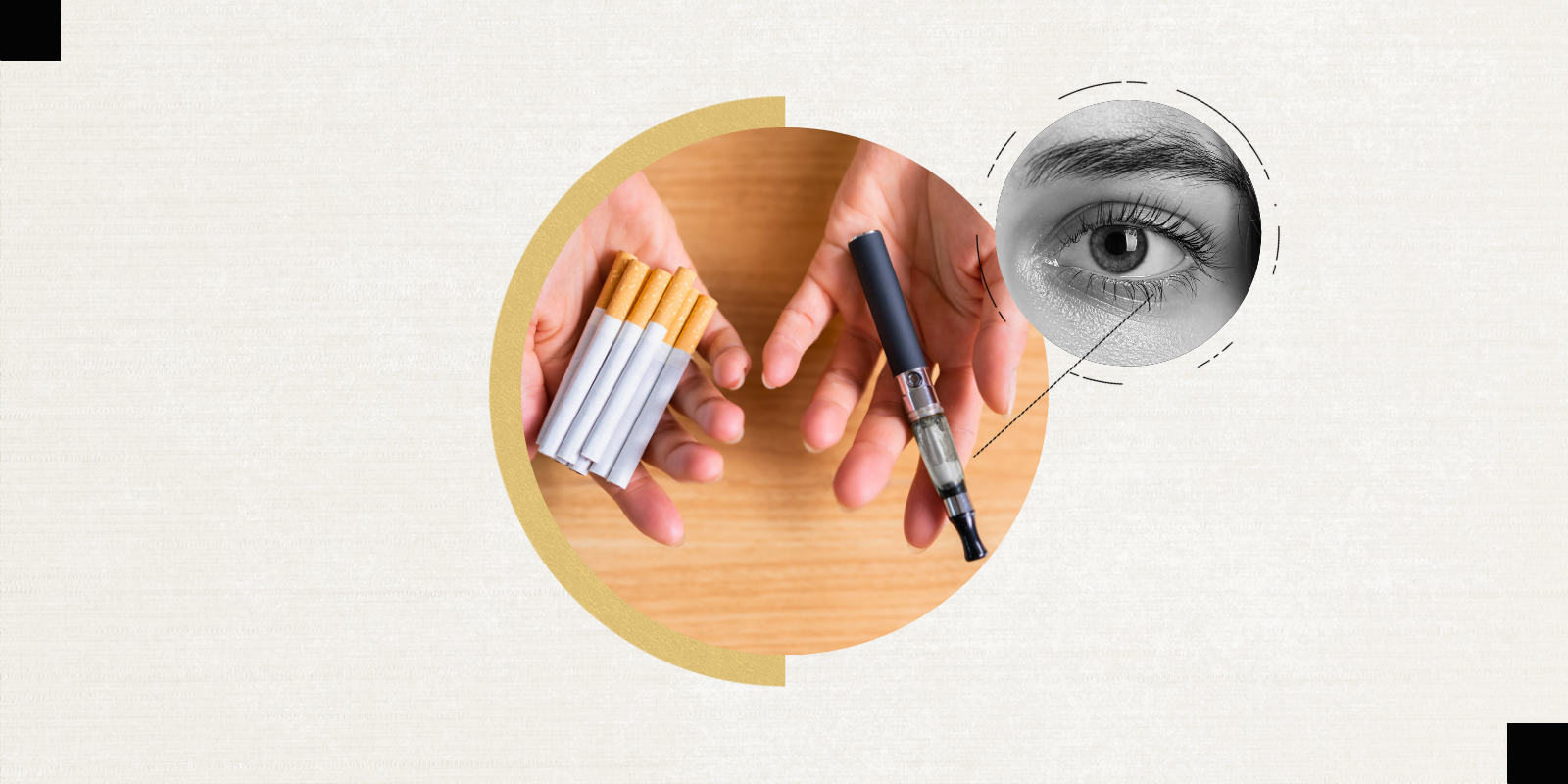
Broadly speaking, in what ways can smoking affect your eye health?
Smoking affects your eyes in different ways. In the short term, you may experience irritation, dryness, redness, or contact lens intolerance because the eyes are dry. Smoking can also delay healing from procedures on the eyes, such as cataract surgery.
In the long term, you may develop or worsen more complex eye conditions. Smoking reduces oxygen delivery to the eye by impairing blood flow, and it increases oxidative stress and inflammation in the eyes. That can lead to the development or worsening of eye conditions like macular degeneration, cataracts, glaucoma, diabetic retinopathy, thyroid eye disease, or damage to the optic nerve (the cord connecting the eyes to the brain). Some of these conditions can cause profound vision loss or permanent blindness.
How does vaping compare to smoking? Does it differ in how it affects the eyes?
Many of the effects are similar because of the nicotine content. However, vaping has other components like propylene glycol (a man-made liquid that is common in vaping products) and other chemical solvents and flavoring agents that can irritate the ocular surface in a unique way compared to smoking.
The long-term effects of vaping are less defined because it’s newer, but there are similar effects to what we’ve seen in patients with chronic nicotine use. This includes increased risk of macular degeneration, glaucoma, diabetic retinopathy, and thyroid eye disease. Long-term smoking and nicotine consumption are known to increase the risk of those conditions, and since vaping products have a lot of nicotine in the vape cartridges, it’s hypothesized that vaping would affect the eyes in a similar way long term.
As you mentioned, many vaping products are known for having high levels of nicotine. Previous research found that one standard vape cartridge has the same amount of nicotine as 20 cigarettes. How does regularly consuming high levels of nicotine affect the eyes?
It causes a lot of vasoconstriction, the narrowing of the blood vessels, which means that less blood — and therefore less oxygen — is delivered to parts of the eye like the retina or the optic nerve. This can accelerate cell aging and cause stress to tissues in the eye. The blood vessels in the eye are some of the most delicate in the body, so they’re particularly susceptible to inflammatory and vascular change.
Nicotine is a known vasoconstrictor, so cigarettes, vaping products, and nicotine pouches all carry that risk to the eyes.
Why do smoking and vaping worsen dry eye symptoms?
There are a lot of chemicals in tobacco that can break down the eye’s tear film, increase the evaporation of tears, and trigger inflammation on the surface of the eye. All of those are factors that can worsen dryness. Smoke can also directly irritate the eyes.
Vaping can also decrease the quality of a person’s tear film and worsen dry eye symptoms.
What are the potential impacts of secondhand smoke on a person’s eyes?
Secondhand smoke can cause a direct irritation to the eyes, including dryness, redness, and worsening allergies. Children are susceptible to that, especially their ocular surface, so it can contribute to the future development of eye conditions if they're exposed to secondhand smoke.
What is still unknown about how smoking and vaping affect the eyes?
In terms of smoking, we don't understand the exact dose-response relationship. How much exposure leads to permanent damage? Why are some patients more vulnerable than others? It's not clearly defined how much smoking equals how much eye damage.
With vaping, we still are discovering the long-term risks. Are the effects of vaping the exact same as smoking, or do they differ? And similarly, we still need to learn how much vaping use equals how much eye damage.
Some people may assume that vaping is less harmful to ocular health compared to smoking. To what extent do you agree or disagree with this?
I would partially agree and partially disagree. Vaping still carries all the similar risk factors that come with nicotine consumption. However, you won’t get the same combustion effects that you’d get from traditional cigarettes. In that sense, vaping may be ever so slightly less harmful, but it still carries a lot of harm due to the substantial amount of nicotine.
How does a person’s age and the amount of time they’ve been using cigarettes or vaping products affect their risk?
Risk increases with longer and more frequent use, and it also increases with age. Older populations are more vulnerable to conditions like macular degeneration, glaucoma, diabetic retinopathy, and cataracts. They are also slightly more susceptible to ocular damage from nicotine use, as their bodies are not always able to repair the vascular damage compared to younger populations.
Quitting smoking is reported to improve ocular health at any age. Why is that?
Smoking impairs blood flow and oxygen delivery to the ocular tissues, and it promotes inflammation. When you quit smoking, those issues tend to improve. Circulation improves in the body and the inflammatory activity decreases, which can slow the progression of eye conditions and help preserve vision.
If you regularly smoke or vape, is it possible for your eyes to recover from the damage that these products potentially caused?
It depends on what damage has occurred. For instance, if you’ve had severe damage to the optic nerve, such as glaucoma-related vision loss or macular degeneration, then that doesn’t necessarily recover. Dry eye symptoms, however, often improve once a person stops smoking or vaping.
Overall, reducing or quitting use at any point can help protect ocular health and significantly reduce the risk of vision loss. It’s not easy to quit smoking or vaping, but it really helps protect the eyes long term.